Decking Oil, Stain or Paint? Choosing the Right Finish for a London Garden
Written by Billy Maddox & Vincent O'Connell, Founders of The Tree Amigos Landscaping & Gardening
Published: September 2026
DECKING GUIDE | The Tree Amigos
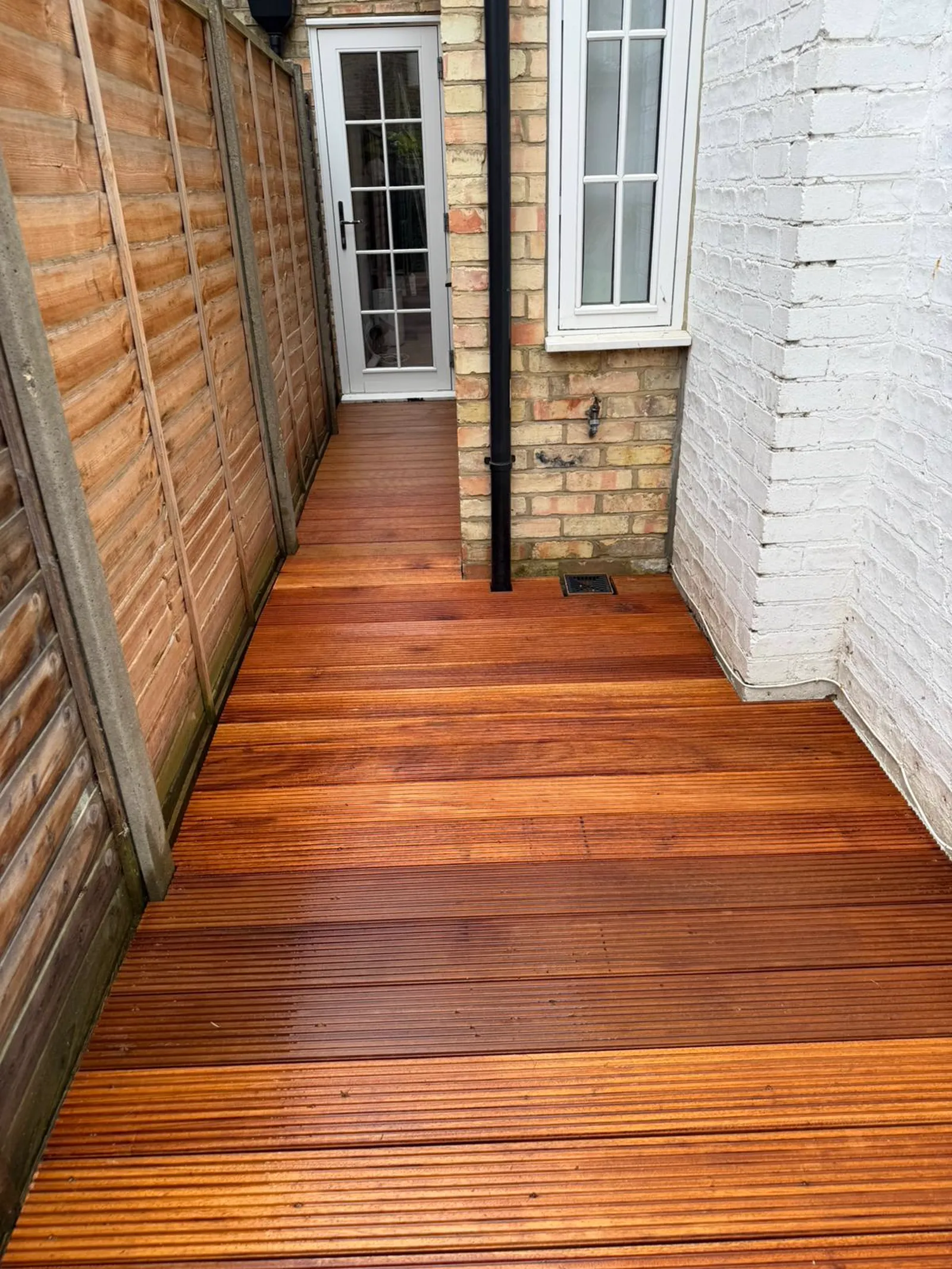
Most "best decking oil" guides online read like disguised product rankings — a list of tins with affiliate links attached, and no real explanation of why one finish outperforms another. This guide is different: we don't sell decking finishes, we've no sponsorship or commission deal with any brand named below, and we've built it from manufacturer technical documentation, independent trade sources, and real UK forum threads rather than marketing copy.
This guide is about picking a coating for timber decking you already have or are about to install — softwood, hardwood, or modified timber like Kebony, Accoya and ThermoWood. If you're still deciding which material to install in the first place, our composite vs timber decking comparison covers that decision. And if your deck is already down and you want the full cleaning, winter-care and subframe routine, our decking maintenance and winter care guide picks up from there. This article sits between the two: it's specifically about the coating on top of the timber, not the timber itself or its ongoing care.
Key Takeaways
- Oil and stain fail by fading — worn patches just lighten, and you clean and recoat with no stripping. Paint fails by peeling — once moisture gets under the film, it cracks and blisters, and full removal is labour-intensive.
- Composite decking (Millboard, Trex) should never be oiled, stained or painted — manufacturers explicitly advise against it and doing so can affect your warranty.
- Modified timber (Kebony, Accoya, ThermoWood) doesn't need a coating for durability at all — it's a cosmetic choice, not a protection requirement.
- Dense hardwoods resist film-forming products; paint on Balau, Ipe or Cumaru is actively discouraged, not just "less ideal."
- We have no affiliate, sponsorship or paid relationship with any brand named in this article — product names are used only as real-world examples.
Oil vs Stain vs Paint — What's Actually Different
Oil penetrates the timber and feeds it; stain is essentially a pigmented oil that colours the wood while still showing the grain; paint forms a full, opaque film on top of the surface. That difference in mechanism is also the difference in how each one fails — and it's the single most useful thing to understand before buying anything.
Independent decking specialists consistently describe it the same way: oil and stain fail by fading, paint fails by peeling. A worn, oiled deck just looks a little lighter — clean it and recoat, no stripping required. A painted deck holds its colour for longer while the film stays intact, but once water gets underneath it — which, on a horizontal, walked-on, repeatedly wet London deck, it eventually will — the film cracks and blisters rather than wearing evenly. Real homeowners confirm the same pattern outside of any manufacturer's marketing: on a DIYnot forum thread comparing decking paint and oil, one user put it plainly: "Once it starts to flake, you're stuffed. No way I was going to waste my life on my hands and knees stripping it out." Another noted plainly that most deck paint "will most definately peel off after a couple of years."
There's also a distinction worth knowing before you buy anything: some general-purpose exterior wood stains carry small-print disclaimers about reduced resistance on horizontal surfaces, because — as one forum poster put it on a thread about stain wearing thin — "you don't usually walk on your furniture." Decking gets constant foot traffic that a fence panel or a garden bench never sees, so it's worth confirming a product is actually sold and rated as a decking oil or decking stain, not a general exterior wood stain being repurposed for a deck.
| Factor | Decking Oil | Decking Stain | Deck Paint |
|---|---|---|---|
| Look & grain | Enhances natural colour, grain fully visible | Colours the timber, grain still visible (semi-transparent) | Solid colour; grain and surface defects hidden |
| How it protects | Penetrates, adds water repellency, feeds the timber | Penetrates and colours; moves with the timber | Forms a surface film; relies on that film staying intact |
| Failure mode | Fades and dries; worn areas simply look lighter | Fades and wears; cleaned and recoated, no stripping | Cracks and peels in sheets once moisture gets underneath |
| Typical reapplication | Roughly every 12 months in a London climate | Roughly every 1-3 years, product and exposure dependent | Can hold for several years if intact, but full repaints are labour-heavy once it starts failing |
| Prep to refresh | Clean, light sand if needed, reapply | Clean and light scuff, then reapply | Scraping, sanding, sometimes chemical stripping before repainting |
One independent labour-cost comparison found that, over a decade, owners of stained decks typically spend less total time and money on upkeep than owners of painted decks — recoating stain is simply a smaller job each time, even though it happens somewhat more often. If you're weighing this up, think in terms of total effort over the life of the deck, not just which option looks lowest-maintenance on day one.
Does Your Deck Even Need Oiling? (Composite vs Timber)
If you've got composite decking — Millboard or Trex being the two we install most — the answer is simple: leave it alone. Trex states plainly that you should "never have to sand, stain or paint" a Trex deck, and that doing so to the walking surface is not recommended and can affect the fade and stain warranty. Millboard is equally direct: its Lastane® surface "does not require staining, painting or sealing," and standard paints and stains "will not properly adhere" to it in the first place. The only sanctioned exception on either brand is a small manufacturer-supplied touch-up product for cut ends or scratches — never a general-purpose oil, stain or paint applied to the boards themselves.
If your deck is composite, the only maintenance it needs is cleaning — our full decking maintenance and winter care guide covers exactly how, including the correct pressure-washing limits and safe de-icing. Everything from this point in this article is about timber: softwood, hardwood, and modified timber.
Choosing an Oil for Softwood Decking
Softwood is the most porous and absorbent of the timbers we install, and it benefits the most from a penetrating finish — it's more prone to surface checking and biological attack than dense hardwoods if left untreated. A good-quality decking oil or pigmented decking stain that penetrates and adds UV protection is the default choice, and softwood can be oiled straight after installation without a seasoning period, unlike dense hardwoods.
Plan on reapplying roughly every 12-24 months depending on exposure — more often on an unshaded, south-facing deck, less often somewhere shaded and sheltered. Paint is only worth considering on softwood that's already badly weathered, mismatched, or patched, where hiding defects matters more than showing the grain — and even then, go in knowing it will eventually need stripping rather than a simple recoat.
Choosing an Oil for Hardwood Decking (Balau, Oak, Ipe, Cumaru, Teak, Garapa)
Dense tropical and European hardwoods behave differently to softwood, and the difference matters for which product actually works. Their natural oils and tight density make adhesion harder for generic stains — trade sources specifically note that "certain high-quality woods (such as tropical woods) will not hold stain very well" — and film-forming paints are actively discouraged on hardwood decking, not just a weaker option. A penetrating decking oil, or a specialist hardwood decking stain, is the right category here: it feeds the timber and respects the grain rather than fighting the wood's own natural oil content.
One genuinely useful, species-specific data point came from a UK woodworking forum thread on finishing Yellow Balau decking — the exact species we install most often. Experienced posters there pointed to Osmo's decking oil range (sold in a clear formulation the same manufacturer also labels as "Teak Oil," since Balau behaves similarly to teak) and Treatex's dedicated Bangkirai/Yellow Balau oil as species-appropriate options, alongside Sikkens Cetol cited as performing "streets ahead of others" in independent exterior wood finish testing. The same thread carried a genuinely useful safety warning worth repeating here: bare or lightly oiled hardwood left to grey naturally "is going to be seriously slippery during the Autumn and winter months" — a real reason to keep an anti-slip additive or textured application in mind for steps and other high-traffic boards, on top of whatever finish you choose.
It's also worth saying plainly: hardwood doesn't need oiling at all for durability. Balau, Ipe, Cumaru and Teak are naturally rot-resistant and can be left to weather to an attractive silver-grey patina with nothing more than occasional cleaning. Oiling is entirely a cosmetic choice for holding the original warmer tone — not a requirement for the deck to last.
Worth knowing before you buy: results on hardwood depend heavily on preparation and application, not just which product you choose. On one DIYnot forum thread specifically about decking oil, opinions genuinely split — one user found the same brand "simply great stuff" lasting two years with proper prep, while another had it fail within months. Neither is more "right" than the other; it's a real illustration of why prep matters as much as the tin you buy.
Modified Timber (Kebony, Accoya, ThermoWood) — Does It Need Finishing at All?
Modified timber is manufactured — by heat treatment, acetylation, or a bio-based process — to be dimensionally stable and highly rot-resistant all the way through, not just on the surface. Manufacturers of Accoya, Kebony and ThermoWood are explicit on this point: coatings are not required for durability or warranty performance. Left uncoated, the timber will simply weather to a silver-grey, exactly as bare hardwood does.
If you want to hold the original colour rather than let it silver, manufacturer guidance points to a UV-protective penetrating oil or translucent stain, reapplied roughly every 2-5 years on sun-exposed faces — never a film-forming varnish, which is specifically discouraged on modified-timber decking boards due to slip risk. The choice here genuinely comes down to colour preference, not protection: you're deciding how the deck looks, not whether it survives.
What to Look For in a Decking Oil, Stain or Paint
Rather than naming a single "winner" — which is exactly the kind of claim we can't stand behind without being paid to make it — here's what actually separates a good decking finish from a weak one, based on manufacturer specifications and independent reviews rather than marketing copy.
- UV-stabilised (pigmented) over totally clear: pigmented finishes hold their colour and protective quality noticeably longer than clear ones, because sunlight discolours timber by breaking down the pigment naturally present in the wood — a pigmented finish is protecting against that mechanism directly, not just adding sheen.
- Water-based vs solvent-based: water-based finishes dry faster and have lower odour, which suits a family garden mid-project; solvent-based versions penetrate deeper and tend to last longer between coats. Neither is objectively "better" — it's a trade-off worth knowing about before you buy.
- Anti-slip additives on steps and high-traffic boards: several manufacturers offer an anti-slip variant or an additive that mixes into decking oil, and it's worth asking for specifically on stairs and heavily-walked areas, where a slip has the highest consequence.
- Coverage rate, not just tin price: coverage per litre varies enormously between products we found in research — from roughly 6-8m² per litre up to around 24m² per litre for some ranges. A cheaper-looking tin with poor coverage can cost more per square metre than a pricier one that goes further — do the per-m² sum before comparing prices.
- Sold specifically as a decking product: as covered above, a finish rated for horizontal, walked-on surfaces is a different product to a general exterior wood stain, even from the same manufacturer.
A note on independence: we've named specific products and brands throughout this guide — Osmo, Sikkens, Ronseal, Liberon, Treatex, Trex, Millboard, Accoya, Kebony and others — purely as real-world examples to explain the differences between finish types and categories. The Tree Amigos has no affiliate, sponsorship, paid placement or commission relationship with any of them. Nothing here is an endorsement; it's a summary of what manufacturer documentation, independent reviews and real UK forum threads report.
When to Apply (and Reapply) in a London Garden
London gets rain on roughly one day in three across the year, with the wettest stretch running November to January and the driest in July — which shapes when finishing work should actually happen. Apply any oil, stain or paint after a full clean and two to three dry days, only above roughly 10°C so the product cures properly rather than sitting wet on the surface. That points most reapplication work toward a dry spell in spring or early autumn — never freezing conditions, which stop the product curing at all and mean redoing the job later.
Autumn, before the weather properly turns, is the single most useful window: it protects the timber through the wettest months rather than leaving it exposed going into winter. If you miss that window, spring is the fallback, once the deck has dried out from winter and before summer UV exposure picks up. Focus your effort on end grain and high-traffic areas first — that's where wear shows earliest, on any finish type.
FAQ: Decking Oil, Stain and Paint
Quick answers to the questions we hear most from London homeowners choosing a decking finish.
Can you paint over decking oil?
No. Paint needs to bond to bare or lightly sanded timber to form its surface film. Applied over an already-oiled deck, it won't adhere properly and will flake away in patches rather than as a clean, even coat.
How often should you oil a deck in London?
Roughly once a year for most London gardens, with high-UV or south-facing decks closer to every 12-18 months and shaded, enclosed gardens able to stretch longer between coats. Annual maintenance is treated as standard by experienced finishers regardless of brand — no oil is a one-and-done product.
Does composite decking need oiling?
No. Composite decking such as Millboard and Trex is engineered to need no oiling, staining or sealing, and manufacturers explicitly advise against applying any of them to the walking surface. See our full decking maintenance and winter care guide for the correct composite cleaning routine instead.
What's the difference between decking oil and decking stain?
Decking stain is essentially a pigmented oil, built to change the timber's colour while still showing the grain. Plain decking oil carries little or no pigment and prioritises feeding and protecting the wood over altering its appearance. Both are penetrating finishes that fail by fading, not peeling.
Do you need to oil hardwood decking?
Not strictly. Dense hardwoods like Balau, Ipe, Cumaru and Teak are naturally rot-resistant and can be left bare to weather to a silver-grey patina. Oiling is a cosmetic choice for readers who want to hold the original warmer tone, not a requirement for the timber's durability.
South East & South West London Decking Specialists
Not Sure Which Finish (or Material) Is Right for Your Deck?
Every London garden has its own shade, drainage and aspect, which changes how any finish performs. No obligation, no upsell — just an honest assessment from the people who'll be doing the work.
To recap: we've named real products and brands throughout this guide purely as examples of finish categories — The Tree Amigos has no affiliate, sponsorship or paid relationship with any of them. For the material decision behind the finish, see our composite vs timber decking comparison; for ongoing cleaning and winter care once your deck is down, see our decking maintenance and winter care guide. Browse our full range of garden services, or see all the areas we cover.
About the Authors
Billy Maddox and Vincent O'Connell are the founders of The Tree Amigos Landscaping & Gardening Ltd, the South East and South West London landscaping firm they run together. Every decking installation and consultation is personally overseen by Billy and Vincent, who work hands-on across gardens throughout the capital. The Tree Amigos are rated 9.8/10 on Checkatrade.