Composite Decking London | Composite & Timber Decking Installers
Trusted across London, with a strong focus on South East London, we provide premium decking installation London services by our founder-led team. Experienced with installing leading composite decking products like Millboard and Trex as well as premium hardwood and softwood timber, Billy Maddox and Vincent O'Connell deliver stunning, custom outdoor living platforms engineered on C24 structural subframes for long-lasting durability.
- 9.8 / 10 Checkatrade, 23 verified reviews
-

- Founder-led by Billy Maddox & Vincent O'Connell
- Every job built by the two founders
Composite Decking in London: What We Install and How We Build It
We install composite decking in London, with Millboard and Trex boards, alongside hardwood, modified timber and softwood decks, across South East and South West London, each on a C24 strength-graded timber subframe with breathable membrane and ventilation underneath. Billy Maddox and Vincent O'Connell survey the garden, build the deck and finish it themselves.
We design and install garden decks in composite (Millboard and Trex), hardwood (Balau, Oak, Iroko, Ipe, Cumaru, Teak and Garapa), modified timber (Kebony, Accoya and ThermoWood) and pressure-treated softwood. Every deck starts with a free on-site survey, so the material, board layout and subframe suit your garden, your ground and how you use the space.
Whatever the surface, we build on a C24 strength-graded timber subframe with breathable membrane and proper ventilation underneath, because most deck failures start below the boards. Billy Maddox and Vincent O'Connell run every project themselves from our Woolwich base, and The Tree Amigos is rated 9.8/10 on Checkatrade.
Find your local page: Greenwich, Lewisham, Bromley, Beckenham, Richmond, Kingston, Wimbledon, Battersea, Croydon, Waltham Forest, or see the full list of areas below. Once your deck is built, our maintenance and winter care guide and our guide to choosing a decking oil, stain or paint cover looking after it, and our composite vs timber comparison helps you choose a material. For the rules before you build, see our guide to planning permission for decking in London, and for brands, our Millboard vs Trex comparison.
Composite or Timber? How the Options Compare
For modern London gardens, composite decking is rapidly replacing traditional timber as the material of choice. While natural wood possesses an undeniable charm, it requires relentless, time-consuming maintenance to prevent it from deteriorating in the unpredictable UK weather. High-quality composite decking fundamentally solves this problem. Manufactured from a robust blend of recycled wood fibers and advanced polymers, it is far more resistant to rotting, warping, and splitting than timber. You will never need to spend your weekends sanding, staining, or oiling your deck again. Furthermore, composite boards are entirely splinter-free and textured for good grip underfoot, making them a practical option for young families and pet owners. A quality composite deck is built to stay looking good for many years with only occasional washing.
| Feature | Softwood | Hardwood | Modified Timber | Composite |
|---|---|---|---|---|
| Average Lifespan | 10–15 years (basic pressure-treated); 20–30 years (premium larch/redwood) | 25–40 years (oak/balau/iroko); 30–50+ years (ipe/cumaru) | 20–30 years (ThermoWood, heat-treated only); 30–60+ years (Kebony, Accoya — chemically/bio-modified) | 20–35 years depending on cap quality; uncapped 10–15, capped 25–35 |
| Upkeep Effort | High: oil/stain every 1–2 years to avoid splitting, warping, algae | Low–Medium: can be left to silver; oil annually to retain colour | Low: occasional clean; optional UV-blocking oil if you want to hold the original colour, otherwise stable and low-maintenance | Very Low: soap & water; capped boards resist stains/fading |
| Splinter Risk | Yes, especially if unsealed or weathered | Low (dense grain), but can check/split if not pre-drilled during install | Low — modification process stabilises the timber, though pre-drilling fixings is still good practice | No (engineered surface) |
| Slip Resistance | Poor when wet/mouldy; algae builds quickly in shade/damp | Moderate; naturally oily species can be slick when wet | Moderate — behaves like natural timber; textured/reeded profiles available | Good; many boards have textured/grained surfaces designed for grip, though algae still needs washing off |
| UV Resistance | Fades & greys quickly; needs UV-blocking oil to retain colour | Greys naturally; oil slows greying but doesn't stop it fully | Greys naturally like hardwood/softwood unless oiled; the modification itself doesn't degrade, only the surface colour fades | Highly fade-resistant, especially capped composites |
| Heat in Sun | Stays cooler than composite; still warms in direct sun | Similar to softwood; dense timber holds some heat but less than dark composite | Similar to natural timber — stays notably cooler underfoot than dark composite | Holds heat longer; dark colours can reach ~50°C+ on a 25°C day vs ~35–40°C for light tones |
Want the full breakdown of how composite and timber compare over the years? Read our complete decking materials guide →
Already have decking or preparing for winter? Read our London decking maintenance & winter care guide →
Millboard vs Trex - Which Composite Decking Is Right for You?
We install both Millboard and Trex, the two leading composite decking manufacturers in the UK, along with other composite brands. While both offer exceptional durability, they cater to different aesthetic preferences and project requirements.
| Feature | Millboard | Trex |
|---|---|---|
| Appearance | Hand-moulded, ultra-realistic natural wood look | Clean, modern, consistent finish |
| Texture | Deeply embossed, pliable elastomer surface | Smooth or lightly grooved protective shell |
| Sustainability | Polyurethane resin and mineral blend (wood-free) | 95% recycled wood fibers and plastic film |
Board Styles & Fixing Systems
The beauty of a premium composite deck lies in its seamless finish. Unlike traditional timber decks which are blighted by visible, rusting screws, modern composite systems utilize hidden fasteners. Trex boards typically employ a hidden clip system that slots perfectly into grooved edges, ensuring uniform spacing and a flawlessly clean surface. Millboard takes this a step further with their proprietary solid boards; their unique Lastane surface self-heals over the specialized Durafix screws, rendering the fixings completely invisible. Whether you prefer the sleek, uniform aesthetic of grooved boards or the solid, architectural feel of square-edged planks, we ensure a flawless, blemish-free installation every time.
Decking Areas We Cover in London
Based in South London, founders Billy and Vincent provide premium composite decking installations across South East London and South West London. We frequently manage extensive decking projects for residential clients in Greenwich, Lewisham, Bromley, Wandsworth, Merton, and Richmond, transforming their outdoor spaces with Millboard and Trex. We also carry out detailed, bespoke installations in Kingston, Sutton, and Croydon. Regardless of your London borough, founders Billy and Vincent personally oversee every phase of the construction to ensure our exacting standards are met.
Our Transformation Process
How we bring your dream garden to life across all 32 London boroughs.
Expert Enquiry
Reach out to discuss your vision with Billy and the team.
On-Site Consultation
A precision survey and design review of your outdoor space.
Bespoke Proposal
A detailed, itemized plan tailored to your garden's potential.
Professional Transformation
Our expert team builds your dream deck with care and creativity.
Frequently Asked Questions
How long does composite decking last?
Is composite decking slippery when wet?
Does composite decking need maintenance?
Why do garden decks fail, and how is yours built to last?
Do I need planning permission for decking in London?
Do you offer a free consultation?
What is the difference between Millboard and Trex?
Does composite decking get hot in summer?
Can composite decking be laid on an existing base?
How long does composite decking installation take?
What's Under the Boards: How We Build the Frame
Most deck failures start below the surface, not in the boards. Whatever board you choose, every deck we build uses the same structure:
- C24 strength-graded timber frame that carries the load properly.
- Breathable membrane over prepared ground, so weeds stay down and ground moisture can escape.
- Joists at 400mm centres (300mm for diagonal board layouts), so boards stay flat and firm.
- Airflow underneath, because a frame that cannot dry out is a frame that rots.
- Structural pedestals and deeper footings where the ground is soft or wet.
- No new boards over an old frame. If the existing frame is not sound, it is replaced.
Want to know what goes wrong when a deck is built cheaply? Read why decks fail and how to build one that lasts.
What's Included in Your Decking Quote
After your free survey you receive an itemised written quote, so you can see exactly what is being built and what you are paying for. A decking quote covers:
- The free on-site survey and measuring up.
- Ground preparation and levelling.
- Breathable membrane.
- The C24 frame, with footings and pedestals where the ground needs them.
- Your chosen boards and fixings.
- Trims, edging and steps, as designed for your garden.
- Waste removal and a clean site at the end.
Anything extra you ask for is itemised separately, so nothing is hidden in the small print.
Decking Questions We Hear Most
Can a deck sit level with my patio or bi-fold doors, and what about air bricks?
Is decking slippery when wet?
What makes a deck rot, and how do you prevent it?
Should I choose timber or composite decking?
How long will my deck last?
Get a Decking Quote in London
How the Free Survey Works
- You get in touch. Send the form, call, or message on WhatsApp. Photos of the garden help but are optional.
- A founder visits. Billy Maddox or Vincent O'Connell comes to the garden and measures the space.
- We check what decides the build: ground, levels, access, trees, and where the deck meets the house, including damp-proof course and air brick positions.
- You see samples and options. We talk through board samples, the frame and how you will use the space.
- You get an itemised written quote showing what is included.
Prefer to talk? Call 07470 419 056.
Decking Pages Across Our Service Area
Every area has its own page covering local ground, planning and access. See the London decking hub for the full range.
South East London
Bexley and Dartford
Bromley and the Kent Edge
South West London and Croydon
North East London
Composite Decking on an Islington Roof Terrace
Old, worn timber decking replaced with composite boards, plus new fencing and trellis, artificial turf and a raised sleeper planter bed. Considering decking on a roof? See the full Islington roof terrace makeover or read what to check before you build.
Balau Hardwood Decking
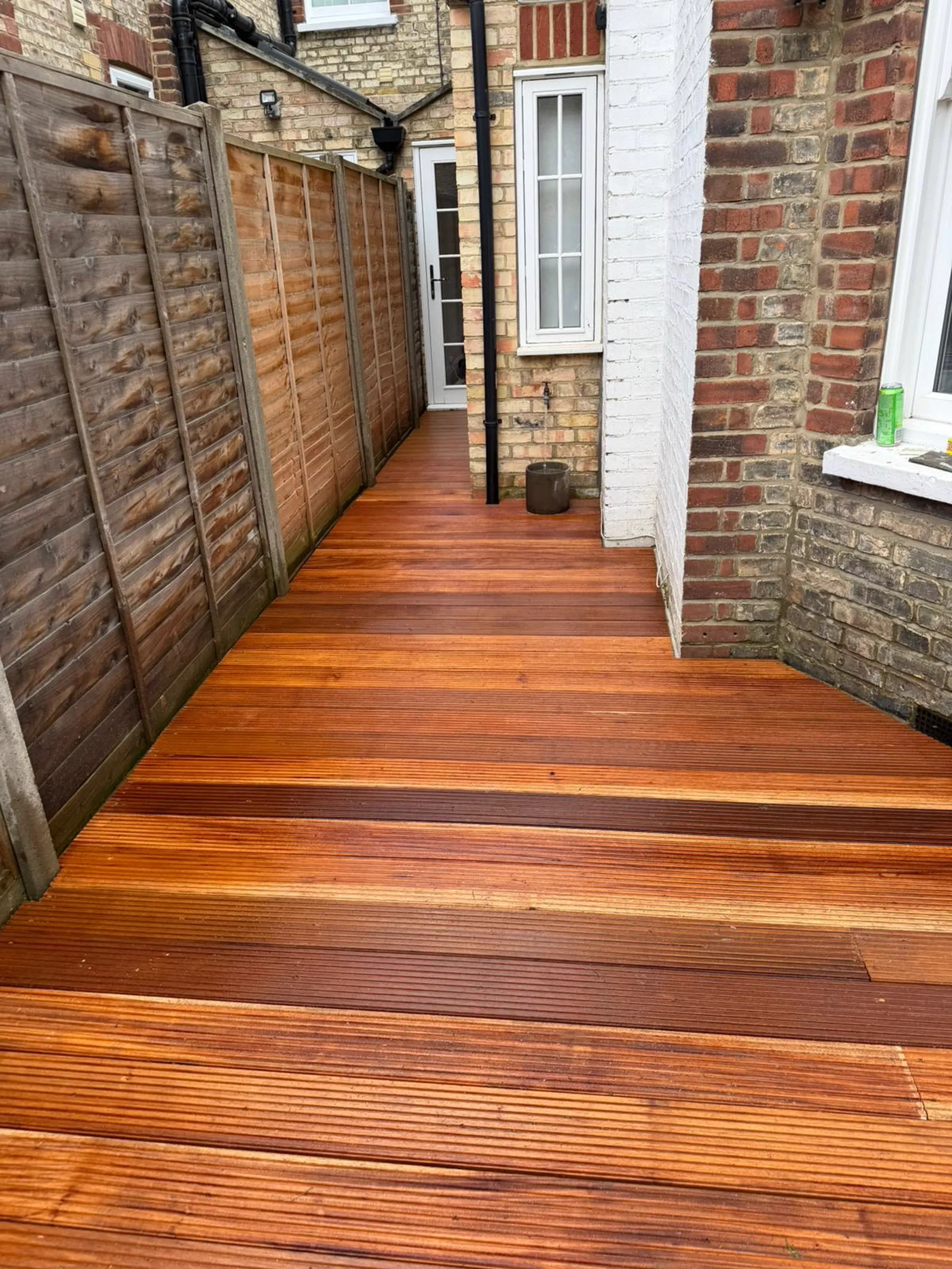
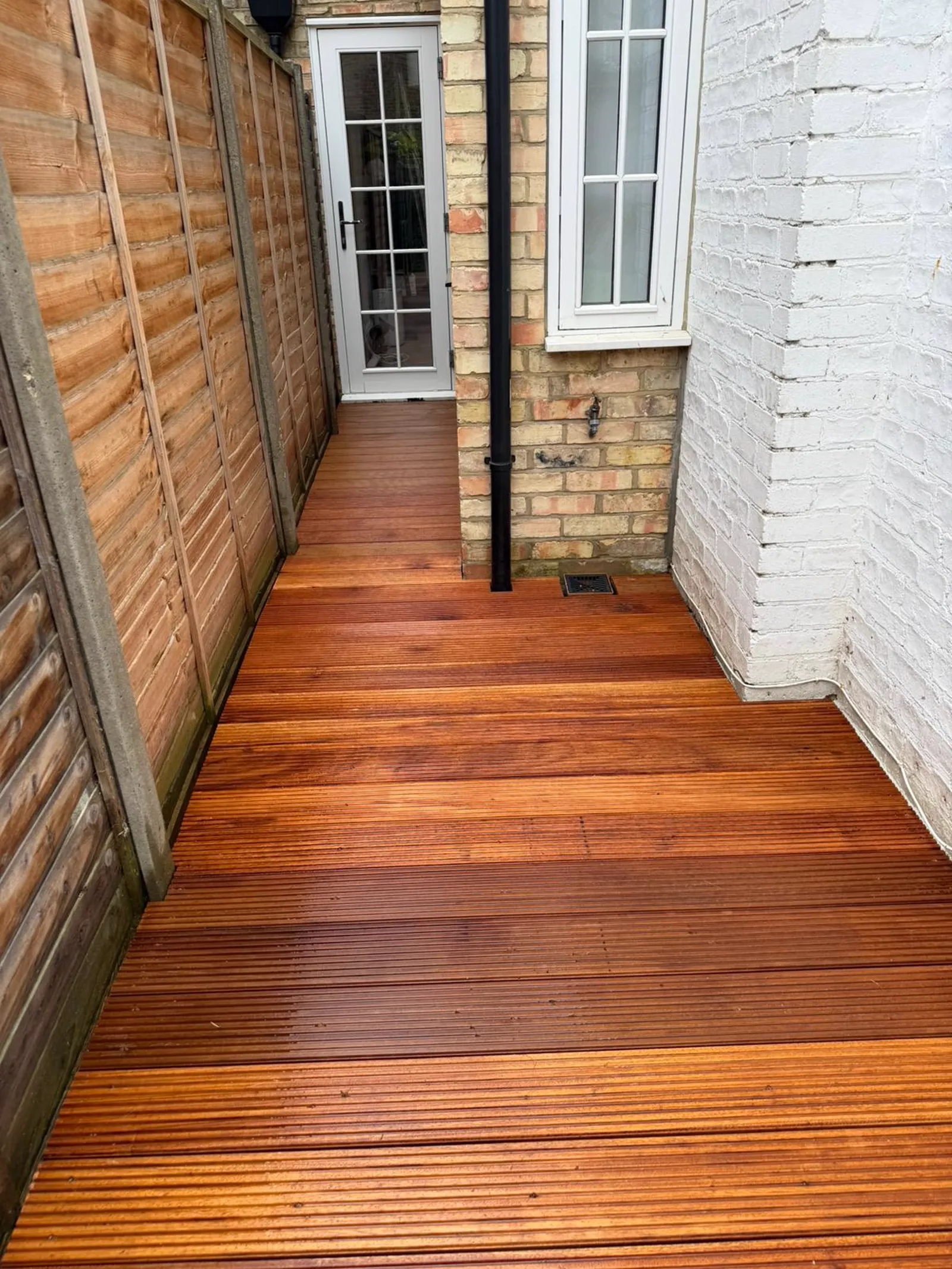
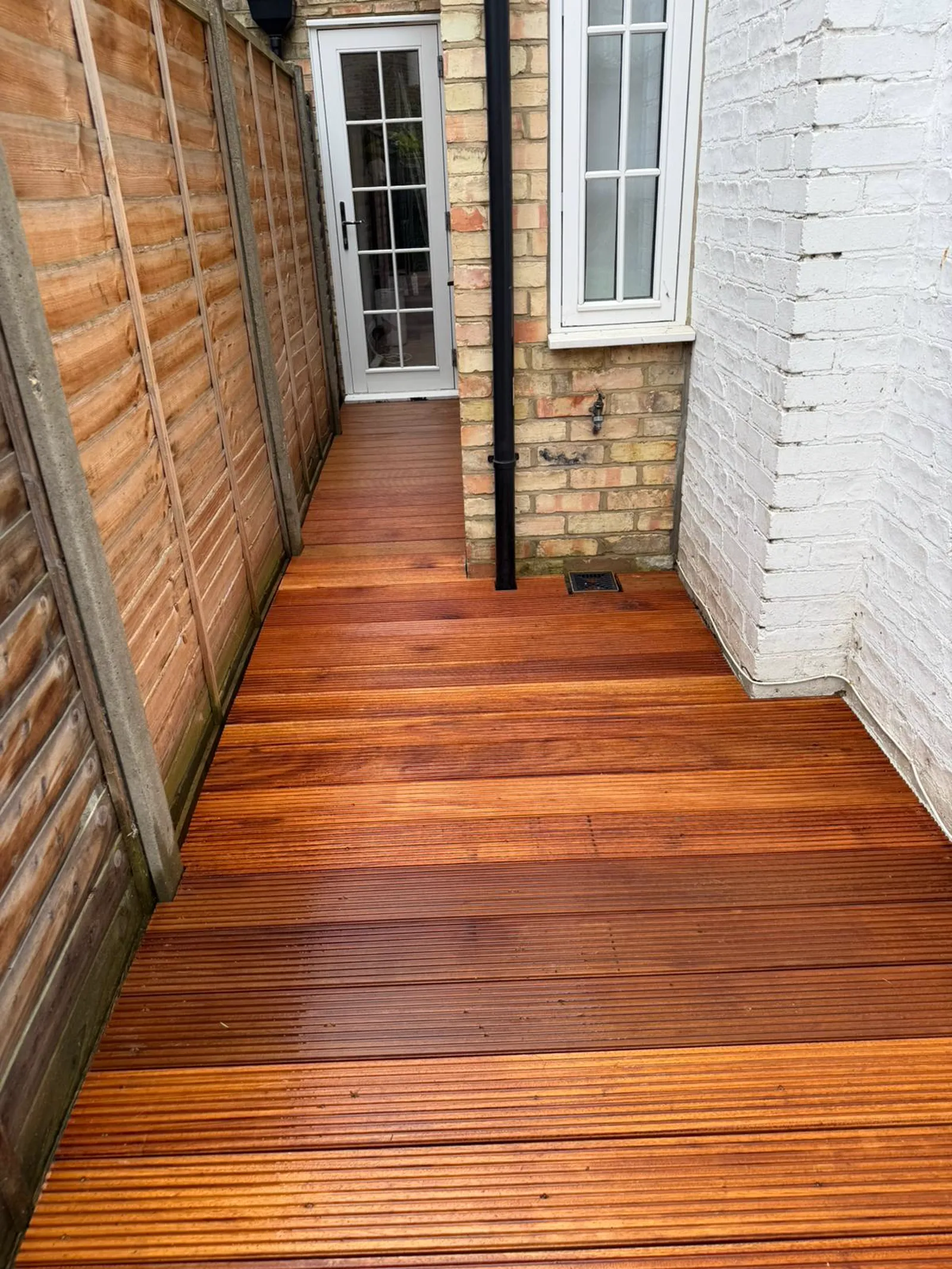
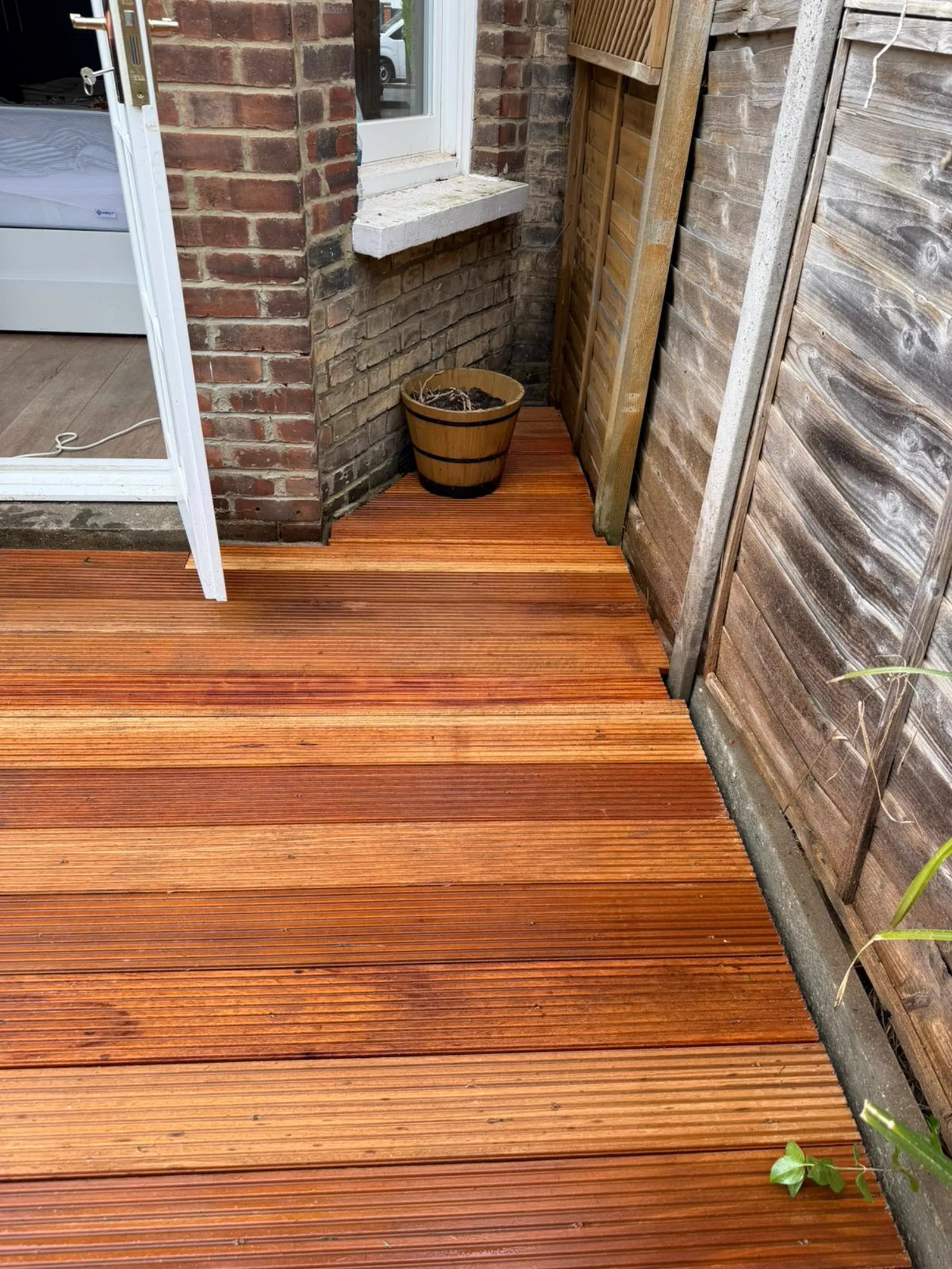
A recent Balau hardwood decking installation by The Tree Amigos Landscaping, South East London — showcasing the rich natural grain and warm tones of premium hardwood timber.
Decking Installers by London Location
Explore our dedicated composite and timber decking services across London: