The Ultimate London Guide to Garden Decking: Materials, Maintenance, and Winter Care
Written by Billy Maddox & Vincent O'Connell, Founders of The Tree Amigos Landscaping & Gardening
Published: September 2026
DECKING GUIDE | The Tree Amigos
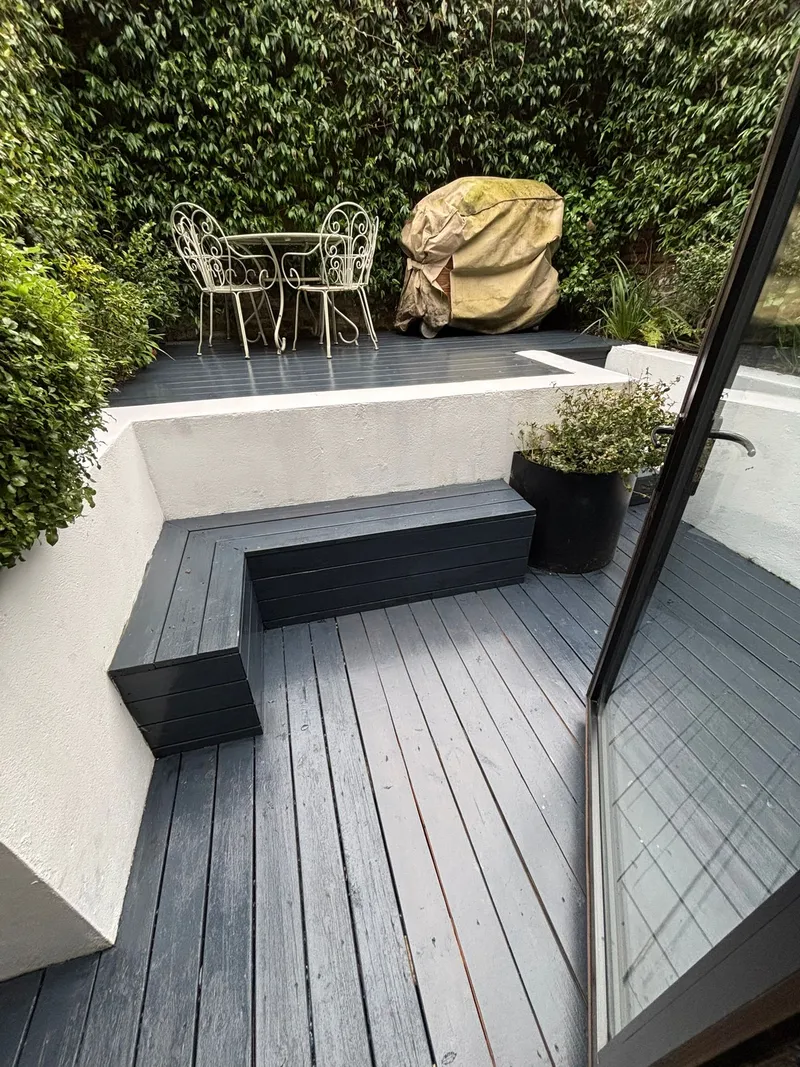
Most decking guides tell you how to sweep the top of your boards and call it a day. That's not why London decks fail. In our experience fitting decks across all 32 boroughs, a deck rarely gives up because the surface looked tired — it gives up because the frame underneath it rotted quietly, out of sight, while everyone was busy sweeping leaves off the top.
London gardens have a particular set of problems: long damp winters, high brick walls and close-set fencing that trap shade, and city air that leaves a film of grime on every surface it touches. Composite decking (Millboard, Trex) copes with most of this with very little input from you. Timber — softwood, hardwood, or modified timber like ThermoWood, Kebony and Accoya — asks for more regular attention, but rewards it with a look you can't fully replicate in composite.
This guide covers both, focused entirely on ownership: how to clean your deck, protect it through winter, spot problems before they become expensive, and avoid the mistakes we see most often in South East and South West London gardens. If you're still deciding which material to install, our composite vs timber decking comparison covers pros, cons and costs — this guide picks up from there, once the deck is already down. Fencing faces much the same winter exposure, so if storm damage or rot is also a concern for your boundary, our ultimate guide to garden fencing covers repairs and protection in more detail.
Key Takeaways
- Composite decking (Millboard, Trex) needs little more than a soap-and-water clean a few times a year; timber needs a proper autumn deep-clean and re-oiling routine to survive a London winter.
- Washing-up liquid (Fairy Liquid) genuinely is manufacturer-recommended for cleaning composite decking — it isn't a myth, as long as you skip the bleach and abrasive pads.
- The "3/4/5 rule" in decking is a frame-squaring check, not a joist-spacing rule — the two get confused constantly online.
- Most deck failures start in the subframe, not the boards — wet leaves trapped between boards block drainage and rot the frame from underneath.
- Realistic lifespan for quality composite decking in UK conditions is 25–35 years with basic maintenance.
London Gardens, Damp Winters, and Why Deck Care Matters
Decking in London faces a long, damp winter with frequent rainfall and occasional frost or snow — conditions that accelerate algae growth, make surfaces slippery, and shorten the working life of both composite and timber decking if they're left unmanaged. Autumn leaf-fall combined with winter moisture traps water on deck surfaces, encouraging the algae and mould that make decks dangerously slippery and speed up decay in timber boards and subframes.
- The terraced-garden trap: Boroughs like Greenwich, Lewisham, Wandsworth and Merton are full of gardens boxed in by high brick walls or close-board fencing, creating heavy shade and "damp traps" that never fully dry out. North-facing and enclosed decks are the ones we see with algae problems every winter.
- Urban grime: London air carries pollution, soot and general city dust that settles on every outdoor surface, including your deck. Cleaning here isn't only about leaves — it's about washing off the city as much as the garden.
Composite is engineered to handle this with minimal input: no annual sealing or staining, and generally free from rot. Timber demands a more active seasonal routine — cleaning, drying, and re-oiling — but any deck, composite or timber, benefits from a simple routine rather than a once-a-year scramble.
Decking Materials at a Glance
A quick summary if you need the context — for a full breakdown of pros, cons and costs, see our dedicated composite vs timber decking comparison.
Millboard
Uses a polyurethane core with a Lastane® surface layer, making it non-porous, resistant to mould and rot, and free from any requirement for annual sealing or staining. It's one of the most realistic wood-look composites on the market and the reason we install it across so many London gardens.
Trex
A capped composite — a protective shell wrapped around a recycled core — that only needs periodic soap-and-water cleaning to keep its appearance and protective layer intact. It's one of the most widely fitted composite brands in the UK, with ranges to suit different budgets and finishes.
Softwood
The most affordable timber option but the least forgiving over a London winter — it absorbs moisture readily and needs the most consistent maintenance.
Hardwood
Balau, oak, ipe and cumaru are denser and naturally more rot-resistant than softwood, but still need annual oiling to stay looking their best.
Modified Timber
ThermoWood, Kebony and Accoya are treated to be more dimensionally stable and rot-resistant than standard timber, sitting between hardwood and composite for maintenance demands.
Deciding what to install?
This guide is about caring for a deck you already have. If you're still weighing up composite against timber — including cost — head to our Composite vs Timber Decking in London breakdown first.
Your London Decking Seasonal Maintenance Calendar
A simple calendar keeps you ahead of problems rather than reacting to them once a board has warped or algae has taken hold.
For composite decks, autumn preparation is mostly a thorough clean and a structural check underneath — not sealing or treatment. For timber, this is the single most important maintenance window of the year: get the deep clean and re-oiling done before the weather turns, and you avoid most winter problems entirely.
Routine Cleaning: Composite Decking (Millboard & Trex)
Most composite decks in London need only light, regular cleaning to stay looking new.
- Sweep debris regularly with a stiff broom or soft brush to stop moisture-trapping build-up between boards.
- Wash with warm soapy water, working along the direction of the boards rather than across them, so you don't force dirt into the drainage gaps.
- Millboard's own care guidance recommends cleaning at least twice a year, more often in shaded or damp spots — which, in a typical enclosed London garden, is most of them.
- Trex's guide to cleaning composite decking confirms its high-performance boards generally need nothing more than soap and water to maintain their protective cap layer.
Does Fairy Liquid Clean Composite Decking?
Yes — and this one isn't a myth. Mild washing-up liquid with warm water is explicitly recommended by the major composite manufacturers, including both Millboard and Trex, for routine cleaning. The only caveat is what you add to it: skip bleach, ammonia-based products, or anything abrasive, and a bottle of washing-up liquid is a genuinely manufacturer-endorsed cleaner, not a homemade workaround.
Should You Jet Wash Composite Decking?
Pressure washing is allowed on composite decking, but within limits. Keep the nozzle roughly 300mm from the surface, use a fan tip (40–60°) rather than a narrow or "turbo" jet, and stay within manufacturer pressure limits — broadly up to around 2,000 psi for Millboard and up to around 3,100 psi for Trex's high-performance ranges. Get too close, or use a needle jet, and you risk exposing screw holes or damaging the cap layer. If in doubt, soap and water with a brush does the job without the risk. The same caution applies to any porcelain or sandstone patio area next to your deck — see our guide on how to clean a patio safely with a pressure washer for the equivalent rules on hard landscaping.
Routine Cleaning: Timber Decking
Timber decks need a more thorough routine to manage algae, general dirt and fibre wear.
- Start by sweeping with a stiff brush to clear loose material and organic debris — avoid metal scrapers, which can gouge the surface.
- Use a specialist timber decking cleaner, not bleach or general household detergent, which can bleach the wood unevenly or leave residue.
- Rinse thoroughly and let the deck dry for two to three days in dry, breezy conditions before doing anything else to it.
- Avoid high-pressure washing where possible — it raises the wood grain, erodes fibres, and forces water deep into the timber, which is the last thing you want before winter.
Is It Better to Stain or Oil Decking?
For most UK softwood and hardwood decking, oil is the more common and more forgiving choice — it's breathable, penetrates the wood rather than sitting on top of it, and is easier to maintain year to year. Stain builds more colour and UV protection into the surface but tends to build up in layers over repeated applications, which eventually needs stripping back. Whichever you choose, apply it after a full deep clean, once the timber has dried for two to three days, and only above roughly 10°C so the product cures properly. Focus your effort on end grain and high-traffic areas — that's where wear shows first.
De-Icing, Snow, and Winter Covering
Composite decking copes with frost and snow well, but de-icing still needs care to avoid surface damage.
Millboard advises using granulated white (pure) salt sparingly, and avoiding coarse rock salt — the grit in it can scratch the Lastane surface. Rinse any salt residue off with soapy water once temperatures rise. Trex decking can tolerate calcium chloride or standard rock salt, but rinse it off as soon as practical, and always use a plastic shovel — never metal — shovelling along the direction of the boards to avoid scuffing.
For timber, avoid harsh rock salt where you can; wood-safe or pet-safe de-icers, or simply hot water, are gentler options. Sweep away meltwater promptly so it doesn't refreeze. Clear snow with a plastic shovel and soft brush rather than letting it sit — the weight and prolonged moisture from a snow layer left on timber boards is a common cause of winter damage. And never apply oil or stain in freezing conditions; it won't cure properly and you'll be redoing the job in spring.
Should you cover your decking in winter? If you do, use a breathable cover — never plastic sheeting, which traps moisture underneath it and makes algae and rot worse, not better. In most London gardens, you're better off skipping a full deck cover altogether and instead storing furniture, plant pots, and barbecues off the deck for winter, which removes the damp patches and pest hiding spots they create far more effectively than covering the whole surface would.
Algae, Moss and Slippery Surfaces in London's Damp Climate
This is where London's garden layout works against you. Algae and moss thrive wherever leaves and standing water are left in place, and the high walls and fencing typical of terraced London gardens create exactly the shaded, poor-airflow conditions algae needs. Regular sweeping is the simplest prevention — don't let leaf litter sit in the gaps between boards. Trimming back overhanging branches and climbing plants improves light and airflow, helping the surface dry out faster after rain, which matters more in a boxed-in London garden than almost anywhere else.
For established algae, use a manufacturer-recommended deck-safe cleaner or biocide rather than a DIY vinegar or bleach mix, which can do more harm than good on composite surfaces. On timber, anti-slip strips or slip-resistant additives mixed into decking oil are worth adding to steps and other high-traffic areas, where the consequences of a slippery surface are highest.
The Part of Your Deck Most Guides Forget: The Subframe
Nearly every decking guide online tells you how to clean the top of your boards. Almost none of them talk about what's underneath — and that's usually where the real problem starts.
When wet leaves and debris pack into the gaps between boards over autumn and winter, they don't just sit on the surface — they block the drainage that's supposed to let water run off the deck. Instead, that water pools on the subframe below, and a timber subframe that stays wet for long periods will rot from the inside out, long before any damage is visible from above.
A Few Checks That Catch This Early
- Probe timber joists for soft spots with a screwdriver — healthy timber resists the point; rotten timber gives way easily.
- Check joist hangers, brackets and fixings for corrosion or loosening, and replace with appropriately rated stainless steel hardware where needed.
- Confirm the deck has proper fall so water drains away rather than pooling, and keep ventilation gaps underneath clear of soil, leaves and plant growth.
- Walk every board and tighten or replace any fixings that have lifted due to seasonal movement.
This is exactly the kind of check that's easy to skip because it's invisible day to day — which is precisely why it's worth building into your autumn routine rather than waiting until a board feels soft underfoot.
Common Decking Mistakes We See Across London Gardens
- Letting leaves and debris build up between boards, trapping moisture and feeding algae growth.
- Pressure washing too aggressively, close to the surface, which damages timber fibres or a composite board's protective cap layer.
- Using coarse rock salt on composite decking, scratching the surface when a finer, manufacturer-approved salt would have done the job safely.
- Leaving heavy snow sitting on timber decks for days at a time, adding weight and prolonged moisture exactly when the wood is least able to dry out.
- Ignoring the subframe entirely — by far the most common mistake, and the one most likely to turn into an expensive repair rather than a routine clean.
FAQ: Garden Decking Maintenance and Winter Care
Quick answers to the questions London homeowners ask us most about decking upkeep.
What is the 3/4/5 rule for decking?
A frame-squaring check, not a joist-spacing rule — a distinction that gets confused online more often than not. It's based on the Pythagorean theorem: measure 3 units along one side of the deck frame and 4 units along the adjacent side, then check the diagonal distance between those two points. If the frame's corner is a true 90°, that diagonal will measure exactly 5 units (decks.com's guide to squaring a deck frame covers the full method). Joist spacing is separate: typically 400mm centres for boards laid straight, or 300mm for diagonal layouts.
Does Fairy Liquid clean decking, including composite decking?
Yes. Mild washing-up liquid mixed with warm water is a manufacturer-endorsed cleaning method for both Millboard and Trex composite decking, provided you use it with a soft or stiff brush and avoid adding bleach or abrasive products. It's also suitable as a gentler alternative for timber decking, though a specialist timber cleaner is generally recommended for a proper deep clean.
What is the best composite decking cleaner in the UK?
For routine cleaning, warm water and a mild washing-up liquid is what manufacturers themselves recommend — there's no need for anything more specialist for day-to-day upkeep. For established algae or stubborn staining, a deck-safe cleaner or biocide recommended by your decking manufacturer is the better choice over a generic household cleaning product.
What is the average lifespan of composite decking?
Realistically, 25–35 years in UK conditions with basic maintenance (London Decking Specialists' lifespan guide gives a useful UK-specific breakdown). Warranty terms range from 25 years on entry lines up to 50 years on premium capped ranges like Trex Transcend and Signature; Millboard offers a 25-year limited residential warranty, and TimberTech up to 30 years. Warranties are conservative — real-world service life is often longer with correct installation and basic cleaning.
Which brand of composite decking is best in the UK?
Millboard and Trex are consistently rated among the top-tier composite brands in the UK market for quality, realistic finish and warranty backing, which is why we install both — EnviroBuild's UK brand comparison places them in the same top bracket. TimberTech is a well-regarded premium alternative, and brands like Eva-Last and Ecoscape are solid mid-range options.
Where do deck boards often rot first?
Not in the open, well-ventilated middle of a board — rot almost always starts at joist ends and bearings, where a joist meets a post or masonry and stays damper for longer, and at board cut-ends where butt joints leave two exposed end grains close together with poor airflow. Decks.com's guide to deck joist rot points to the same pattern: the top of the joist and every screw hole driven into it is where water collects and decay begins.
South East & South West London Decking Specialists
Thinking About a New or Replacement Deck?
Every London garden has its own microclimate — shade, drainage, wall height and aspect all change what a deck needs to last. No obligation, no upsell — just an honest assessment from the people who'll be doing the work.
Composite Decking
Millboard and Trex installation, engineered for London's damp winters and low upkeep.
Timber Decking
Softwood, hardwood and modified timber installation, built on a properly specified subframe.
Free Site Consultation
Billy or Vincent assess your garden's microclimate and recommend the right material for a new or replacement deck.
We work across all 32 London boroughs, from Richmond and Kingston in the south west to Greenwich and Bromley in the south east. Browse our full range of garden services, or see all the areas we cover.
Decking Installation Near You
Greenwich · Lewisham · Bromley · Bexley · Woolwich · Plumstead · Blackheath · Eltham · Lee · Welling · Bexleyheath · Sidcup · Chislehurst · Orpington · Beckenham · Erith · Belvedere · Dartford · Kingston · Richmond · Wimbledon · Raynes Park
About the Authors
Billy Maddox and Vincent O'Connell are the founders of The Tree Amigos Landscaping & Gardening Ltd, the South East and South West London landscaping firm they run together. Every decking installation and consultation is personally overseen by Billy and Vincent, who work hands-on across gardens throughout the capital. The Tree Amigos are rated 9.87/10 on Checkatrade.