Is Your Fence Storm-Ready? How to Tell If You Need a Simple Fence Repair or a Full Replacement
Written by Vincent O'Connell, Co-Founder of The Tree Amigos Landscaping & Gardening
Published: September 2026
FENCING & BOUNDARIES | The Tree Amigos
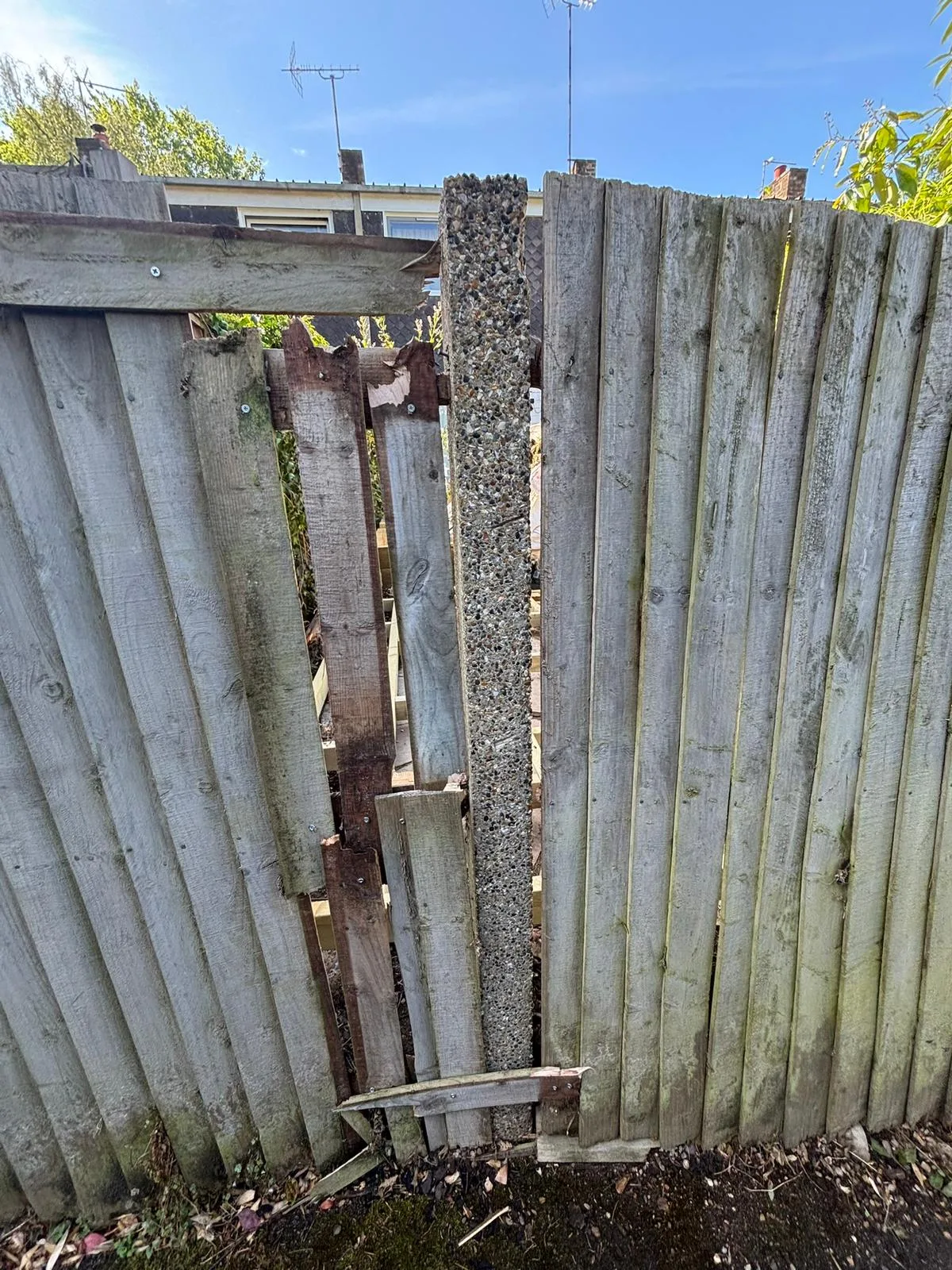
If you're standing in your garden right now looking at a leaning panel or a post that's given way, you don't need another explainer on how fences are built — you need to know whether your fence is storm-ready enough to fix, or whether you're looking at a full replacement. This guide is exactly that: a fast, hands-on triage you can run yourself before you call anyone, with the real diagnostic tests, the hidden reason so many London posts fail even when the timber looks sound, and the cost numbers that tell you when repair stops making sense.
If you want the fuller picture first — fencing types, installation depth, and general storm-proofing — that's covered in our ultimate guide to garden fencing. This article picks up where that one leaves off, for the specific moment you're dealing with right now.
Quick Summary (TL;DR):
Run a screwdriver probe 50–100mm above ground and a two-direction push test on every post near the damage. Sound timber that just needs a panel swap runs roughly £45–£110 a bay; a full replacement runs roughly £60–£130 a metre in London. Once about a third of your posts and panels need work, replacement usually costs little more than repair — and don't count on insurance to cover it, since only around 1% of UK buildings policies actually pay out for storm-damaged fencing.
This Season's Storms, and Why "Not Your Fault" Doesn't Mean "Leave It"
If your fence went down this year, it had real weather to contend with. The Met Office's review of the 2025/26 storm season names Storm Amy, Bram, Chandra and Dave as the storms that crossed the UK across autumn, winter and into spring, with Storm Amy in particular producing gusts over 92mph in exposed locations — an unusually severe storm for October. Storm Bram followed in December with winds over 69mph landing on already-saturated ground.
Worth knowing before you judge your fence too harshly: Met Office wind warnings are impact-based, not tied to one fixed gust speed. A colour rating (yellow, amber, red) reflects both how bad the weather could be and how likely that is for your specific area, which is why a fence in an exposed South East London garden — open ground around Woolwich, Plumstead and the Greenwich riverside — can come down in weather that barely troubles a sheltered garden two streets over. If your fence failed this season, that's information about your site's exposure, not necessarily a verdict on how well it was built.
Three Tests to Run Before You Call Anyone
Our main fencing guide covers the general signs of a failing fence — leaning posts, rot, loose panels. What it doesn't cover is exactly how to test for them with anything more precise than "give it a push." Here's the version we actually use on-site.
Safety First
Before you touch anything, treat a leaning fence or a loose panel as a hazard until you've checked it — severe weather guidance is explicit that flying debris and falling structures are a genuine danger-to-life risk in amber and red wind events. Keep children and pets clear, stay well away from anything near overhead power lines, and only get close once you're confident the run is stable underfoot.
Test 1: The Screwdriver Probe
Press a flathead screwdriver into the post 50–100mm above ground level — this is where ground-contact timber decays first. UC4-rated ground-contact timber is treated to withstand exactly this zone; if the screwdriver sinks in easily or the wood crumbles away, that post is no longer performing as structural UC4 timber, whatever it looked like from a distance. Sound wood should resist the point firmly. This isn't a British Standard test with a pass/fail number attached — it's the practical trade method for finding hidden decay before you commit to a repair.
Test 2: The Two-Direction Push
Hold each post at roughly mid-height with both hands and rock it firmly two ways: in line with the fence run, then perpendicular to it. Posts set correctly — around 600mm deep in solid concrete for a typical 6ft fence, as covered in our fencing guide — shouldn't move at the ground line in either direction. Any movement at all where the post meets the soil points to a failed footing or decayed timber below ground, even if the post looks straight above ground.
Test 3: Read the Failure Pattern
The pattern of damage tells you almost as much as the tests themselves. If your panels are still intact but one or more posts have snapped or rotted at the base, that's a post problem — often fixable with a concrete repair spur bolted alongside the original post, without touching the panels. If the posts pass both tests but individual panels are cracked, bowed, or torn free of their fixings, that's a panel problem, and swapping the affected bay while the structure underneath is sound is usually the most economical fix. Mixed damage — several posts and several panels — is the pattern that tends to tip toward full replacement, which the cost section below explains in more detail.
Before you tidy anything up
If there's any chance you'll want to claim on insurance, take dated, wide-angle photos of the whole affected run first, plus close-ups of the failed posts or panels, before you clear anything away. It won't guarantee a payout — see the insurance section below — but it's the evidence insurers and loss adjusters typically ask for if a claim is possible.
The Hidden Reason Your Post Failed: London Clay
Here's something worth understanding if the push test moved a post that otherwise looks and probes fine: London Clay is a genuinely difficult material to set a fence post into, and it's a big part of why South East London gardens see more storm-related fence failures than the timber quality alone would explain. High-plasticity clay like London's can expand by around 10% in volume when saturated and shrink back significantly as it dries out, and that shrink-swell cycle has been measured to a depth of several metres in places.
We want to be precise about what that does and doesn't explain. There's no single study that measured "fence posts failing in London Clay during named storms" — what we're describing is a reasoned mechanism, not a documented cause-and-effect study: a post set into clay that cracks open in a dry spell, then saturates and swells during a wet, windy storm, loses some of the tight grip a concrete footing depends on. That's a plausible and practically useful explanation for why a post can fail a push test even when the timber itself probes sound — but treat it as informed reasoning about your soil, not a guarantee of what happened to your specific fence.
The Real Cost Math: When Repair Stops Making Sense
Once you know what's actually failed, the decision usually comes down to money. UK fencing cost guides for 2026 put a single panel repair — materials and fitting — at roughly £45–£110 per bay, while a full new 1.8m timber fence runs approximately £60–£130 per metre installed, with London and the South East typically sitting toward the higher end of that range.
There's a rule of thumb worth knowing before you start collecting quotes: once roughly a third of a fence's panels and posts need work, a full replacement typically costs little more overall than a series of piecemeal repairs — and you end up with a straight, matched run under one guarantee instead of a patchwork of old and new timber sitting side by side. If a storm has taken out several bays along one boundary, it's worth getting the maths done properly rather than assuming repair is automatically cheaper.
Post lifespan factors into that calculation too. A properly treated UC4 softwood post set with good drainage and a solid concrete footing typically lasts around 10–20 years; slotted precast concrete posts are the more durable option, generally rated at 25–30 years. If the posts you're repairing around are already well into that first bracket, a repair today is a shorter-term fix than the same repair on a five-year-old post.
Not sure which side of that line you're on?
Billy and Vincent will run these exact tests on-site and give you a straight answer — repair or replace — with an itemised quote either way, free and no obligation.
What Your Insurance Will (and Won't) Pay For
"Only around 1% of UK buildings insurance policies cover storm damage to fences and gates."
— based on Defaqto policy analysis, reported by Norton Insurance Brokers, July 2026
That figure surprises a lot of people, and it explains a pattern we see constantly: homeowners wait weeks for an insurance assessor before calling a landscaper, hoping a claim will cover the cost, when the overwhelming likelihood is that it won't. Most UK insurers have explicitly excluded storm damage to fences and gates from standard buildings cover since decisions taken after the storms of the late 1980s — the reasoning being that fences are exposed, semi-permanent structures rather than the kind of sudden, unforeseeable damage buildings insurance is designed for.
We want to be careful here: this is general industry data, not a statement about your specific policy. Some insurers do offer optional garden cover add-ons, and terms vary. Before you assume either way, check your own policy wording or ask your insurer directly — and if it turns out you're not covered, at least you'll know that early, rather than after weeks of waiting.
If It's a Shared Boundary: A Quick, Honest Note
When a boundary fence comes down, the "whose fence is it anyway" question comes up almost immediately — and the common belief that you can always tell from which side the fence posts face is a myth. Legal ownership of a boundary fence in England and Wales is properly determined by the "T marks" on the HM Land Registry title plan for the property, where they exist and are recorded; not every property has them marked, and not every boundary dispute is worth solving from a blog post. If you're unsure, it's genuinely worth a quick look at your title register before assuming either way.
Either way, an early, straightforward conversation with your neighbour tends to go a lot further than a formal dispute — and if you'd rather have someone independent assess the damage and put a number on it first, that's exactly what a free on-site survey is for.
FAQ: Fence Repair vs Replacement After Storm Damage
How do I know if my fence is storm damaged or just old and worn out?
Run the screwdriver probe test 50–100mm above ground and the two-direction push test on each post. Storm damage tends to show as a sudden lean or snapped timber with sound wood elsewhere, while age-related failure usually shows as rot spreading from ground level even on posts that look straight.
Will my home insurance pay for a storm-damaged fence?
Usually not. Industry analysis of UK buildings policies found only around 1% actually cover storm damage to fences and gates, since most insurers have excluded this specific risk since the storms of the late 1980s. Always check your own policy wording rather than assuming either way.
How much of my fence needs to be damaged before replacing it is cheaper than repairing it?
As a rule of thumb used across the UK fencing trade, once roughly a third of a fence's panels and posts need work, a full replacement typically costs little more overall than piecemeal repairs, and you get a matched run under one guarantee instead of a patchwork of old and new timber.
South East London Fencing Specialists
Not Sure If It's a Repair or a Replacement?
Billy and Vincent will run the same probe and push tests on-site, explain exactly what they find, and give you an honest, itemised quote — whether that's a simple repair or a full storm-proof rebuild.
For the full picture on materials, installation depth, and general storm-proofing, see our ultimate guide to garden fencing. The Tree Amigos repair and replace fences across all 32 London boroughs, with a focus on South East London — Woolwich, Plumstead, Greenwich, Eltham, Blackheath and Lee. See all the areas we cover.
About the Author
Vincent O'Connell is co-founder of The Tree Amigos Landscaping & Gardening Ltd, the South East London landscaping firm he runs with Billy Maddox. Vincent has over five years of hands-on experience building and repairing boundaries across London, from Victorian terraces to exposed riverside plots, and runs the probe and push tests in this guide on real jobs every week. Every Tree Amigos project is founder-led and Checkatrade-verified at 9.8/10.