Indian Sandstone Paving Slabs: Colours, Sizes and What to Look For in London
Written by Billy Maddox & Vincent O'Connell, Founders of The Tree Amigos Landscaping & Gardening
Published: October 2026
MATERIALS GUIDE | The Tree Amigos
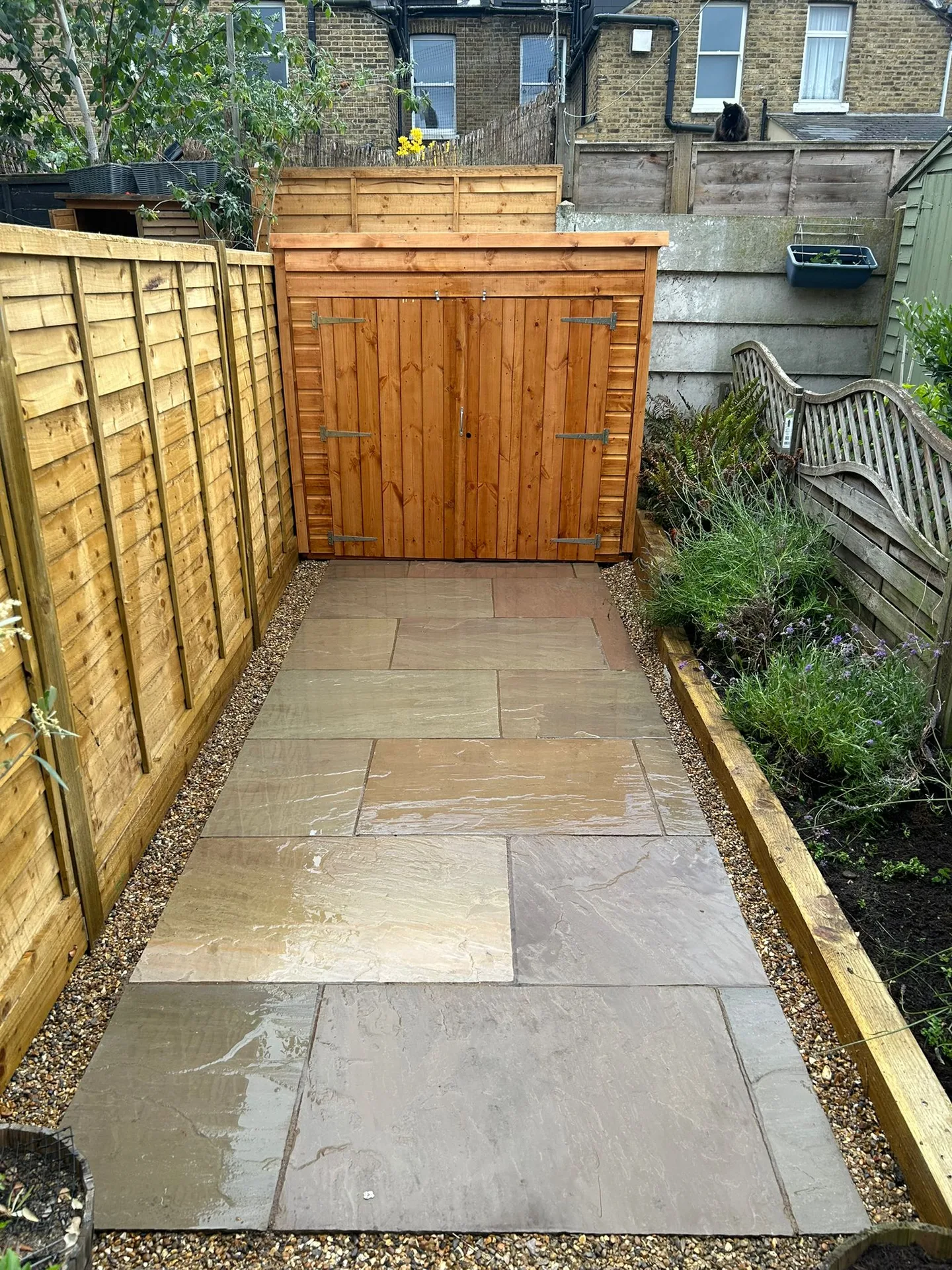
Search for Indian sandstone paving slabs and you'll find hundreds of colour swatches and very little explanation of what separates a good slab from a disappointing one. Two patios made from "Indian sandstone" can look and behave completely differently depending on the colour range, whether the stone is calibrated, how it was laid and where it was quarried. This guide covers the decisions that actually matter before you choose.
We lay natural stone patios across South East and South West London, so this is written with London gardens in mind: damp winters, a lot of shade, and small plots where every slab is on show. If you're still weighing sandstone against a manufactured alternative, our porcelain vs Indian sandstone comparison covers that decision. This article assumes you've leaned towards natural stone and want to choose well.
Key Takeaways
- Kandla Grey is the most popular colour; Raj Green and Autumn Brown are the main multi-tone alternatives. Every colour looks lighter dry and richer wet.
- Calibrated slabs are machined to an even thickness and are far easier to lay accurately than uncalibrated stone.
- Sandstone is porous: priming the slabs, using a full mortar bed and sealing properly are what stop staining and salt bloom.
- Ask where the stone was quarried and whether the supplier is part of an independent ethical-trade scheme.
- Natural variation is the point of the material. Judge a colour from several full slabs, not one small sample.
What Are Indian Sandstone Paving Slabs?
Indian sandstone is a natural sedimentary rock, quarried mainly in Rajasthan and split or sawn into paving slabs. Because it's formed in layers, each slab has its own banding, markings and tone. That variation is what people are paying for, and it is also what catches out buyers who expect every slab to match a catalogue photo exactly.
Most paving slabs sold in the UK are either riven (hand-split, with a textured, naturally uneven face) or sawn (cut, with a flatter, more uniform finish). The riven face is what gives Indian sandstone its familiar grip underfoot and traditional look; sawn stone suits a cleaner, more contemporary style.
Indian Sandstone Colours: What You're Actually Choosing Between
Most ranges fall into a handful of families. The names vary slightly between suppliers, but the character is consistent:
| Colour | Typical character | Suits |
|---|---|---|
| Kandla Grey | Silver-grey to mid-grey, often with darker movement or fine veining. The most popular range. | Modern and mixed schemes; works with most house brick and render |
| Raj Green | A natural mix of green, grey and brown tones with plenty of variation between slabs. | Traditional and cottage-style gardens, period homes |
| Autumn Brown | Light to deep brown with charcoal and rust tones. | Warm schemes, red or yellow London stock brick |
| Mint / buff tones | Soft cream and beige with occasional darker veins. | Lighter, brighter small gardens |
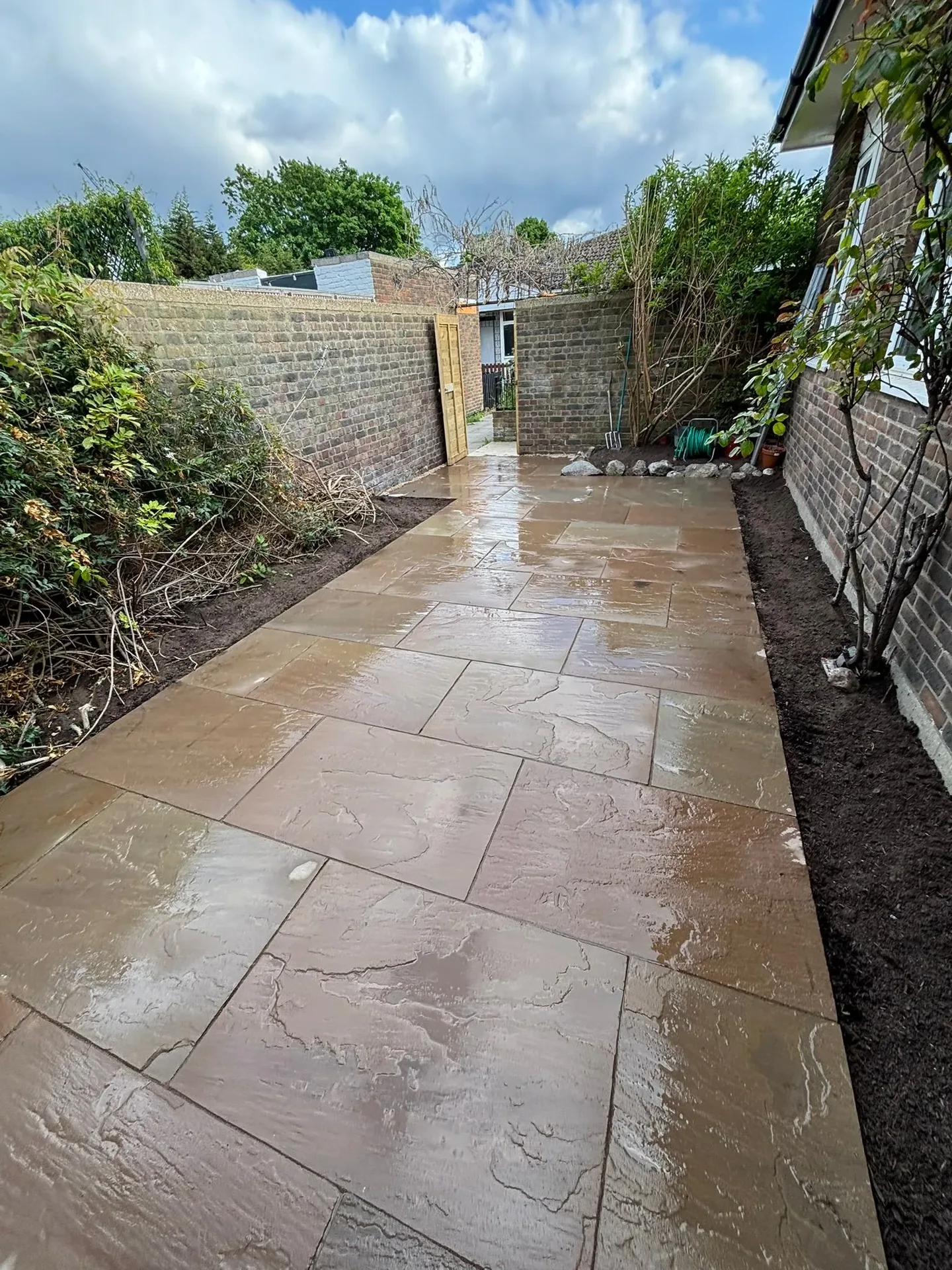
Two practical points that rarely make it onto product pages. First, colour changes with moisture: suppliers describe Kandla Grey as a light silver-grey when dry that deepens noticeably when wet, and Raj Green and Autumn Brown both turn richer after rain (London Stone's colour guide covers the ranges in detail). In London, where the patio is wet for a good part of the year, that wet colour is the one you'll live with most. Second, judge from full slabs, not a postage-stamp sample. Natural variation within a single range is large, and a small sample can't show it.
Calibrated vs Uncalibrated Slabs: Why Thickness Matters
Calibrated slabs have been machined to a consistent thickness. Uncalibrated slabs are simply as they came from the quarry, so thickness varies from slab to slab. We use 22mm calibrated stone for our own patios, and the reason is practical: with an even thickness, slabs sit level on the mortar bed, joints stay consistent, and the finished surface doesn't have the rocking slabs and trip edges that uneven stone can produce.
Uncalibrated stone isn't automatically bad. In skilled hands it can be laid beautifully, and some people prefer its rougher, more rustic look. But it demands more time and more skill to bed accurately, which is worth factoring in when you compare a lower-priced slab with a calibrated one. The cheaper slab can cost you more in laying.
Slab Sizes and Layout: Single Size or Mixed Pack?
Sandstone is usually sold either as single-size slabs, which lay in a clean grid, or as mixed-size packs that create a random, cobbled-together pattern. Mixed packs suit traditional gardens and hide small irregularities well. Single-size slabs suit a more ordered, contemporary look and make it easier to plan cuts around edges and borders.
In a small London garden, larger slabs generally make the space feel less busy, because there are fewer joints. A mixed-size pattern in a tight, awkward-shaped plot can look fussy. This is a design call for your own garden rather than a rule, and it's one we usually talk through on site where we can see the space.
How Indian Sandstone Behaves in a Damp London Garden
Sandstone is porous, and that single fact explains most of the problems people report. Porous stone absorbs water, and anything dissolved or carried in it: organic staining from leaves, algae in shaded corners, and salts that can migrate to the surface as a pale bloom called efflorescence. Fresh stone laid on an unprimed, patchy mortar bed is where most of these problems start.
How we lay it addresses that directly: a compacted MOT Type 1 sub-base, SBR slurry priming on the back of each slab, and a full wet mortar bed rather than the five-dab method that leaves voids underneath. Priming and full bedding limit how much moisture and salt can move through the slab from below, and they stop the hollow spots that crack stone. You can read more about our laying process on the Indian sandstone paving hub page.
Sealing
Most sandstone patios benefit from a breathable impregnating sealer, which helps resist staining and algae without trapping moisture in the stone. The timing matters: the stone should be fully dry and any early efflorescence should have cleared before you seal, otherwise you can lock salts in. How long that takes depends on the stone and the weather. We typically seal a few weeks after laying, while some trade guides advise waiting through a full season. If anyone quotes a fixed number of days without checking the stone is dry, treat it with caution.
Grip, Algae and Cleaning
The riven surface gives sandstone good natural grip, but no paving stays safe if algae and moss build up in a shaded, damp garden. Regular sweeping and a gentle clean keep it that way. If you're thinking of pressure washing, read our guide on how to clean a patio safely with a pressure washer first, because too much pressure can strip the surface and wash out joints.
Ethical Sourcing: The Question Most Buyers Don't Ask
Most Indian sandstone sold in the UK comes from Rajasthan, and the industry has a documented history of labour problems in quarries and processing sites, including child and bonded labour. The Ethical Trading Initiative's Sandstone Working Group, made up of UK hard-landscaping suppliers, publishes guidance on the ethical sourcing of Indian sandstone for exactly this reason.
Whoever supplies and fits your stone, it's reasonable to ask: where was it quarried, is the supplier a member of an ethical-trade scheme, and is the supply chain independently audited? A confident supplier will answer straight away. A vague answer, or a price that looks too good against comparable stone, is worth questioning.
Is Indian Sandstone Right for Your Garden?
Indian sandstone suits gardens where you want natural character, warm tones and a surface with grip, and where you're happy to seal it and give it a periodic clean. It's a weaker fit if you want an identical, uniform finish across every slab, or a surface that never needs any attention at all. For that, our porcelain vs sandstone guide and our broader best patio material comparison are the better starting points.
FAQ: Indian Sandstone Paving Slabs
Quick answers to the questions we hear most from London homeowners.
What is the most popular Indian sandstone colour?
Kandla Grey is widely regarded as the most popular Indian sandstone colour in the UK, followed by the multi-tone Raj Green. Autumn Brown and the pale, buff-toned Mint ranges suit warmer, more traditional schemes.
What is the difference between calibrated and uncalibrated Indian sandstone?
Calibrated slabs are machined to a consistent thickness, which makes laying faster and the finished surface more even. Uncalibrated slabs vary in thickness, so they take more skill to lay without rocking slabs or uneven joints.
Does Indian sandstone need sealing?
Usually yes. Sandstone is porous and can absorb stains and encourage algae in damp, shaded gardens, so a breathable sealer is normally recommended once the stone is fully dry and any early salt bloom (efflorescence) has cleared.
Is Indian sandstone slippery when wet?
The riven, hand-split surface of Indian sandstone gives good natural grip, but any paving can become slippery if algae or moss is allowed to build up. Regular cleaning matters more than the stone itself.
Does Indian sandstone change colour?
Yes. Most Indian sandstone looks noticeably lighter when dry and deeper and richer when wet, and colours can soften slightly with weathering. That is normal behaviour for natural stone, not a defect.
South East & South West London Paving Specialists
Thinking About an Indian Sandstone Patio?
Billy or Vincent can talk you through colours, layout and laying on a free site visit. No obligation, just an honest recommendation for your garden.
Indian Sandstone Paving Near You
London hub · Greenwich · Blackheath · Eltham · Woolwich · Plumstead · Lee · Bromley · Beckenham · Chislehurst · Orpington · Sidcup · West Wickham · Merton
About the Authors
Billy Maddox and Vincent O'Connell are the founders of The Tree Amigos Landscaping & Gardening Ltd, the South East and South West London landscaping firm they run together. Every paving installation and consultation is personally overseen by Billy and Vincent, who work hands-on across gardens throughout the capital. The Tree Amigos are rated 9.8/10 on Checkatrade.