Porcelain vs Indian Sandstone (Indian Stone) Patios: Which Should You Choose?
Written by Billy Maddox & Vincent O'Connell, Founders of The Tree Amigos Landscaping & Gardening Ltd
Published August 2026 · Updated November 2026
MATERIALS GUIDE | The Tree Amigos
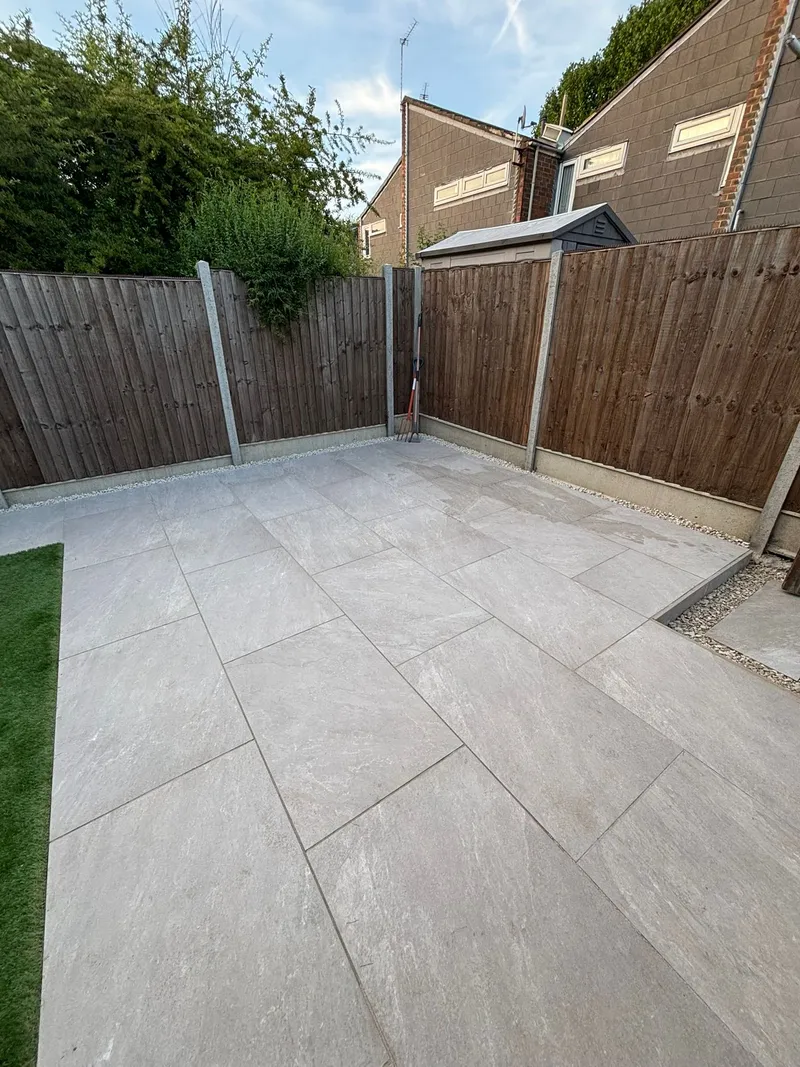
Choose porcelain if you want a non-porous patio that resists algae, frost and stains and only needs washing. Choose Indian sandstone, often called Indian stone, if you want natural colour variation and character, especially on an older house, and you are happy to seal and clean it. Both make a good patio in a UK garden, and both depend far more on the base they are laid on than on the surface itself. This guide sets the two side by side so you can decide.
Key Takeaways
- Porcelain is non-porous, so it resists algae and stains and does not need sealing.
- Indian sandstone is natural and porous, so it needs sealing and periodic cleaning in damp London gardens.
- Sandstone suits period homes; porcelain suits modern gardens and low-maintenance households.
- Either one fails if the base is poor, so the sub-base matters more than the slab.
If you are still weighing up other surfaces, our guide to choosing the best patio material for UK weather looks at the wider options. This page is only about the two we install most: porcelain patios and Indian sandstone paving.
Porcelain and Sandstone at a Glance
| Porcelain | Indian sandstone | |
|---|---|---|
| Look | Clean, uniform, modern. Stone, concrete and timber effects are available. | Natural colour variation, riven texture, sold in colours such as Kandla Grey, Raj Green and Autumn Brown. |
| Porosity | Non-porous | Porous |
| Sealing | None needed | Recommended, and re-sealed from time to time |
| Algae and stains | Resists them; wipes off | More prone, especially in shade, unless sealed and cleaned |
| Slip resistance | Choose an outdoor-rated tile (R11 is usual) | Decent natural grip, but slick if algae builds up |
| Laying | Specialist work: a very flat base, a primer on the tile and a full mortar bed | Traditional masonry, but slabs vary in thickness, so it takes care to lay level |
| Repairs | A broken tile needs a close match | A single slab can be swapped, and a replacement blends in |
| Best for | Modern courtyards, family gardens, low upkeep | Period houses, cottage and traditional gardens |
Indian Sandstone: Natural, with Care
Indian sandstone is a natural sedimentary stone that has been a standard paving material in Britain for decades. Every slab differs, and that variation is the appeal. It sits well against Victorian and Edwardian brick and suits traditional gardens. It also feels softer and warmer underfoot than a hard, glossy surface.
The trade-off is upkeep. Sandstone is porous, so in a damp London garden it takes up moisture, and algae and black spot appear more easily where it is shaded. Sealing it after installation helps, and washing it gently as needed keeps it looking good. Slabs also vary in thickness, so laying them level takes more care than laying a uniform tile. Our Indian sandstone paving guide goes into colours, sizes and what to look for.
Porcelain: Low Upkeep, Exact Laying
Porcelain paving is a dense ceramic fired at very high temperatures. It is non-porous, so water does not soak in, which makes it far more resistant to algae, frost damage, stains and fading than natural stone. It never needs sealing, and washing is normally enough. Choose a tile made and rated for outdoor use, with a textured surface and a thickness of 20mm, because indoor tiles are not suitable outside.
Porcelain is less forgiving to lay. It needs a very flat, stable base, a bonding primer on the back of the tile and a full bed of mortar, because it shows up any movement underneath and any gaps behind it. That is why the installer matters. Ask how the base will be built and how the tiles will be bonded before you choose a quote. For examples near you, see our porcelain patio pages for Greenwich, Blackheath, Bromley and Merton.
The Base Matters More Than the Surface
Whichever you choose, the patio will only last as long as what it is laid on. A typical good specification means digging out to a proper depth, compacting a Type 1 sub-base in layers, and setting the paving on a full mortar bed rather than a few dabs. On London clay, water also needs somewhere to go, so levels, falls and drainage are part of the base, not an extra. A cheap quote often means a thin base. Ask installers to describe theirs. We also cover this in our patio planning guide, including when a patio, front garden or raised area needs permission.
Frost, Damp and Algae: How Each Behaves Through a UK Winter
Frost damage comes from water getting into a material, freezing and expanding. Porcelain paving is vitrified, with a water absorption that is typically below 0.5 per cent, so very little water gets in to freeze. Indian sandstone is a sedimentary stone with a porous structure, so it takes up more water. A good slab laid on a properly drained base copes with British winters for decades, but it is more prone to algae and black spot in shade and on damp ground, which is why we recommend sealing it. In a shaded or north-facing garden that stays damp, porcelain is the lower-maintenance choice.
Which Suits Which Garden?
- Shaded or north-facing garden: porcelain, because it resists algae and does not hold moisture.
- Victorian or Edwardian brick house: Indian sandstone often sits better with the look of the building.
- Modern extension with bi-fold doors: porcelain gives a clean, level line from inside to outside.
- Family garden with children or pets: porcelain is easier to wipe clean.
- You like natural variation and accept the upkeep: Indian sandstone, sealed and cleaned as needed.
Which Should You Choose?
If you have children or pets, a shaded garden, or simply do not want to think about it again, porcelain is the easier choice. If the house is period and you like the look of natural stone, sandstone is right as long as you accept sealing and occasional cleaning. If you are torn, think about the garden rather than the catalogue: how much shade it has, how the house looks from the patio, and who will use the space. We are happy to talk it through at a site visit.
Once it is laid, our guide to cleaning a patio with a pressure washer explains how to keep either surface in good condition without damaging it.
Porcelain or sandstone for your garden?
Billy and Vincent will look at the garden, talk through the options and give you a written quote with no obligation.
Related reading:
Choosing between porcelain and sandstone?
We can lay either, and we will tell you which suits your garden at the free site visit. See porcelain patio installation or Indian sandstone paving, then ask for a free quote.
Frequently Asked Questions
Is porcelain or Indian sandstone better for a London garden?
It depends on the house and how you live. Porcelain suits modern gardens and anyone who wants a surface that only needs washing. Indian sandstone suits period properties and people who like natural variation and are happy to seal and clean it every few years.
Does Indian sandstone need sealing?
Yes, we recommend sealing it. Sandstone is a natural, porous stone, so in damp London gardens it takes up moisture and grows algae and black spot more easily if it is left unsealed. How often it needs resealing depends on the stone, the sealer and how shaded the patio is.
Does porcelain need sealing?
No. Porcelain is non-porous, so it does not need sealing. Washing with a mild detergent and a soft brush is normally enough.
Is porcelain slippery when wet?
It depends on the tile. Outdoor porcelain is made with a textured, slip-resistant surface, and R11 is the rating usually specified for garden paving. Smooth indoor tiles should never be used outside. Like any surface, it needs washing if algae builds up in shade.
What thickness of porcelain is used for patios?
Outdoor porcelain paving is normally 20mm thick. It is made for garden use, laid on a full bed and base, and is far sturdier than indoor tiles, which are not suitable outside.
Which is easier to repair?
Individual sandstone slabs can be lifted and replaced, and because the stone varies naturally, a replacement blends in more easily. Porcelain is harder to chip, but if a tile does break, you need a close match from the same range, so it helps to keep a few spare tiles.
Can porcelain go over my old patio?
Only if the old base is sound, level and properly drained, which is uncommon. Porcelain shows up any movement underneath, so in most cases the old patio is lifted and the base is rebuilt.
Is Indian stone the same as Indian sandstone?
Yes. Indian stone is the everyday name for Indian sandstone, the natural paving quarried mainly in Rajasthan and sold in colours such as Kandla Grey, Raj Green and Autumn Brown. Both names describe the same product, so when you see porcelain vs Indian stone, it is the same comparison as porcelain vs Indian sandstone.
Does porcelain or Indian sandstone last longer in UK frost?
Both last for decades when laid on a properly drained base. Porcelain is vitrified and has very low water absorption, so frost has little water to act on. Indian sandstone is porous and takes up more water, so it is more prone to algae and surface wear in damp, shaded gardens, which is why we recommend sealing it. The base and the drainage matter more to the lifespan than the surface.
Indian sandstone v porcelain: which is better for a patio?
Neither is better in every garden. Porcelain is non-porous, so it resists algae and stains and needs little upkeep, but it must be laid exactly. Indian sandstone is natural, grippy and suits period homes, but it is porous and benefits from sealing and regular washing. Choose porcelain for a clean, low-upkeep look and sandstone for a natural, traditional one.
Landscapers in South East London and beyond
Patios and paving are part of our landscaping work in these areas: Woolwich, Plumstead, Charlton, Blackheath, Eltham, Lee, Thamesmead, Sidcup, Welling, Bexleyheath, Dartford. We also work across London, including Greenwich, Lewisham, Bexley, Southwark, Bromley, Wandsworth, Croydon, Merton.