How to Clean Your Patio Safely with a Pressure Washer
Written by Billy Maddox, Co-Founder of The Tree Amigos Landscaping & Gardening
Patio Care & Maintenance | The Tree Amigos
A beautiful garden patio is the heartbeat of any London home. Whether it is a contemporary porcelain courtyard in Greenwich, a sprawling Indian sandstone terrace in Bromley, or a stylish composite deck in Wandsworth, your outdoor paving provides a vital sanctuary for summer barbecues, family gatherings, and morning coffees. However, the UK's damp climate, combined with urban pollution and shaded gardens, means that patios can quickly lose their lustre, becoming coated in a slippery layer of green algae, grime, and atmospheric dirt.
When a patio begins to look dull and weathered, most homeowners naturally reach for the pressure washer. It is an incredibly satisfying and efficient way to clean, but it is also a double-edged sword. Used incorrectly, the sheer force of high-pressure water can easily wash out joints, chip natural stone, splinter timber decking, and etch delicate surfaces. That is why safe technique is absolutely vital to protect your investment.
In this comprehensive guide, we will walk you through how to clean your patio safely, look at the common pitfalls to avoid, and explain why we recommend the Kärcher K4 Power Control as a sensible, durable, and highly manageable mid-range tool for DIY patio maintenance.
Why Pressure Washers Are Popular With London Homeowners
London patios face a unique set of environmental challenges compared to rural gardens. The capital's high traffic density and urban density mean that air pollution, soot, and carbon deposits settle on flat surfaces over time. This creates a sticky, dark, greasy film on paving slabs that a standard garden hose and stiff broom simply cannot shift. Scrubbing this film off by hand is back-breaking work that yields disappointing results.
Furthermore, many London properties—particularly Victorian and Edwardian terraces in areas like Lewisham, Clapham, and East Dulwich—have small, enclosed rear gardens. These spaces are often heavily shaded by high boundary fences, neighbouring walls, and mature trees. Without direct sunlight to dry them out, patios in these microclimates remain damp for long periods, especially during the autumn and winter months. This persistent moisture, combined with the heavy London clay soil that naturally retains water beneath the sub-base, creates the perfect breeding ground for green algae, moss, and lichens.
A pressure washer solves these issues by using concentrated water pressure to break the bond between the grime and the paving material, sweeping away years of buildup in a fraction of the time it would take to scrub. For homeowners who want to keep their gardens looking pristine, it is an indispensable tool—provided it is used with care.
Kärcher K4 Power Control: Key Specs Explained in Plain English
If you are looking to purchase a pressure washer for home use, the market can be overwhelming. Within Kärcher's popular lineup, the machines range from the compact K2 to the heavy-duty K7. For the vast majority of London homeowners, the Kärcher K4 Power Control sits in the absolute "sweet spot" of the range according to official Kärcher specifications. Here is a breakdown of why it performs so well in a domestic setting, explained in plain English:
- 130 Bar Maximum Pressure: "Bar" is the measurement of the water's pushing force. At 130 bar, the K4 has more than enough power to blast away thick grime, dried mud, and stubborn moss from garden paths and driveways. It is significantly more powerful than the entry-level K2 (110 bar) and K3 (120 bar) models, which can struggle with deeply embedded dirt.
- 420 Litres per Hour (l/h) Water Flow: While pressure loosens the dirt, the flow rate is what actually flushes it away. A higher flow rate means you can cover large areas much faster. The K4's 420 l/h flow rate makes cleaning a medium-sized patio efficient and prevents the frustrating "striping" effect that occurs when low-flow machines force you to work in tiny, overlapping passes.
- 1.8 kW Water-Cooled Motor: This is a massive upgrade over cheaper pressure washers. Most entry-level machines use air-cooled motors, which can overheat quickly and require you to stop working to let them cool down. The K4 features a water-cooled motor, where the incoming water circulates around the motor housing before being sprayed out. This makes the machine run much quieter, increases energy efficiency, and dramatically extends its overall lifespan.
- 8-Metre High-Pressure Hose & 5-Metre Cable: With a combined reach of 13 metres, you can easily clean a typical terraced garden or a multi-car driveway in Croydon or Bromley without having to constantly drag the heavy wheeled unit behind you or daisy-chain dangerous electrical extension leads across wet ground.
- The Power Control Gun & Vario Power Spray Lance: This is the key safety feature. Instead of guessing how much force you are applying, the Power Control gun features a clear display showing the active pressure level. By simply twisting the Vario Power lance, you can dial the pressure between Soft, Medium, Hard, and Mix modes, ensuring you always match the force to the surface you are cleaning.
- T5 Surface Cleaner (Patio Head): Usually included in the "Home" bundle, this accessory is a game-changer for patios. It houses a spinning arm with two high-pressure nozzles beneath a protective dome. It hovers just above the paving, delivering a perfectly uniform clean while preventing dirty water, sand, and stones from splashing up onto your clean windows, timber fences, or brickwork.
- Plug ’n’ Clean Detergent System: This allows you to slot a bottle of Kärcher stone cleaner or wood shampoo directly into the top of the machine. When switched to "Mix" mode (low pressure), the K4 automatically draws the detergent and sprays it onto the patio, letting you apply cleaning chemicals evenly before pressure washing.
| Model | Max Pressure | Water Flow | Motor | Best For |
|---|---|---|---|---|
| K2 | 110 Bar | 360 l/h | Air-Cooled | Occasional Light Cleaning, Bikes & Garden Furniture |
| K3 | 120 Bar | 380 l/h | Air-Cooled | Light Patios & Small Cars |
| K4 (Recommended) | 130 Bar | 420 l/h | Water-Cooled | Regular Patio & Driveway Cleaning |
| K7 | 180 Bar | 600 l/h | Water-Cooled | Large Driveways, Heavy-Duty & Frequent Use |
Specifications per Kärcher's official UK electric pressure washer range. Always check the current listing for your exact model, as specifications can be updated.
Honest Downsides to Consider
While the K4 is our top recommendation for domestic use, it is not without its minor flaws. It is worth keeping these realistic points in mind:
- Fiddly Initial Assembly: Out of the box, assembling the handle, wheels, and gun storage can be a bit of a jigsaw puzzle, requiring a star-head screwdriver and about 20–30 minutes of patience.
- Stiff Hose Management: The standard high-pressure hose is quite rigid. It can coil and kink easily during use, and reeling it back onto the storage hooks can feel like wrestling a stubborn garden hose.
- Unit Weight: Weighing in at approximately 11.5 kg (without accessories), it is heavier than compact models. While it has sturdy wheels, carrying it up narrow garden steps or through a terraced house requires a bit of muscle.
- Too Much Machine for Tiny Spaces: If you only have a very small, ground-floor balcony or a tiny paved side-return, the K4 is likely overkill, and a smaller cordless option or a simple hand-scrubbing routine might be more practical.
Is the K4 Safe for Porcelain, Sandstone and Decking?
The short answer is yes—but only if you use the correct settings and attachments. Patios and decks are constructed from vastly different materials, and treating them all with a "one-size-fits-all" high-pressure blast is a recipe for disaster. Let's look at how the Kärcher K4 behaves on different garden surfaces:
Can I use a pressure washer on porcelain slabs?
Porcelain is the king of low-maintenance patio materials. Because it is vitrified (baked at temperatures up to 1,200°C), it is incredibly dense, hard, and has a water absorption rate of virtually zero (less than 0.05%). This means that dirt, oils, and algae cannot penetrate the surface of the tile itself; they simply sit on top. Porcelain is highly scratch-resistant and easily withstands the K4's 130 bar pressure without any risk of etching or cracking.
However, the tile is not the issue—the jointing compound (grout) is. Modern porcelain patios are jointed with specialized exterior grouts. If you sweep a high-pressure jet directly along the joints, you can easily blow out the grout, leaving gaps that allow water to seep under the tiles, leading to loose slabs in winter. To clean porcelain safely with a K4, always use the Medium setting on the Vario Lance or, better yet, use the T5 Surface Cleaner. The patio head keeps the nozzles at a safe distance and distributes the pressure evenly, washing the tile clean without disturbing the grouted joints.
What pressure setting should I use on decking?
Decking requires extreme caution. Timber is a natural, fibrous material. If you use too much pressure or hold the nozzle too close, the water will tear the wood fibres apart. This results in a "fuzzy" wood surface texture, severe splintering, and can completely ruin the structural integrity of softwood timber. Even dense hardwoods (like Yellow Balau or Cedar) can suffer from surface scarring if washed too aggressively.
For timber decking, you should always select the Soft setting on the K4's Vario lance and keep the nozzle at least 30cm away from the wood. Always spray along the direction of the wood grain, never across it. If you have premium composite decking, such as Millboard or Trex, the material is much more durable and resistant to water damage, but it can still be scratched by pinpoint high-pressure jets. We recommend using the Medium setting combined with the T5 patio head for a gentle, even clean that will not scratch the wood-grain finish.
Will a Kärcher K4 remove algae and black spots from my patio?
Green algae, moss, and loose dirt are easily swept away by the K4. The mechanical force of the water lifts them off the surface almost instantly. However, \"black spot\" is a completely different beast. Black spots are lichens (a symbiotic combination of fungi and algae) that physically grow *into* the microscopic pores of natural stone, particularly porous materials like Indian sandstone.
If you try to blast black spots off sandstone using high pressure alone, you will end up holding the lance extremely close to the stone. This will carve circular grooves (etching) into the sandstone, permanently damaging the slab and making it even more porous and susceptible to future dirt. To tackle black spot with a K4, you must use a chemical approach. Apply a dedicated outdoor stone cleaner containing sodium hypochlorite or a specialized biocide using the K4's Plug 'n' Clean system in \"Mix\" mode. Let it dwell for the recommended time (typically 30–60 minutes) to break down the lichen's organic structure, and then gently wash the slurry away using the Vario lance on a Medium setting.
Could a pressure washer damage my pointing or grout?
Absolutely. This is the single most common damage caused by DIY pressure washing. Traditional patios are often pointed with a sand-and-cement mortar or a brush-in polymeric jointing sand. When these joints age, they can develop micro-cracks. If you direct a high-pressure jet (especially Kärcher's rotating \"Dirt Blaster\" nozzle) directly at these joints, the water pressure will act like a chisel, blowing the pointing out in chunks.
Once the pointing is damaged, water can penetrate beneath the slabs, washing away the bedding mortar and causing the slabs to rock, crack, or lift. To prevent this, never point the lance perpendicular (90 degrees) to the paving. Keep it at a 45-degree angle, sweep across the joints diagonally rather than along them, and keep the nozzle moving. For block paving, accept that some jointing sand will be washed out, and be prepared to sweep fresh kiln-dried sand into the joints once the patio is completely dry.
Step-by-Step: How to Clean Your Patio Without Damaging It
To get the best results from your Kärcher K4 while ensuring your paving remains completely safe, follow this professional step-by-step cleaning routine:
- Preparation: Remove all garden furniture, plant pots, and toys. Use a stiff garden broom to sweep away loose leaves, twigs, and surface dust. Hand-weed any large weeds growing in the joints. Do not try to blast weeds out with the pressure washer, as this will inevitably wash away the jointing material underneath them.
- Test a Patch: Connect your garden hose to the K4 (ensure the water is turned on fully) and plug the machine into the mains. Before tackling the main patio, select the Soft setting on the Vario Lance and test it on an inconspicuous corner or a spare slab to ensure it does not cause any flaking or discolouration.
- Detergent Application (Optional): If your patio has heavy oil stains, grease, or black spot, use the Plug 'n' Clean system to apply a stone cleaner. Set the lance to Mix mode and spray the detergent evenly over the dry paving. Let it dwell for 15–20 minutes, ensuring it does not dry out (mist it with a little water if it starts to dry).
- Use the Patio Head (T5): For large, flat areas of porcelain, concrete, or composite decking, click the T5 Surface Cleaner into place. Start from the highest point of the patio and work your way down in slow, overlapping sweeps. Keep the patio head flat on the surface at all times to prevent splashback.
- Detailing with the Vario Lance: For corners, steps, and edges where the patio head cannot reach, switch to the Vario Lance. Set it to Medium pressure. Hold the nozzle at a 45-degree angle to the paving, maintaining a distance of at least 30cm, and sweep in a fluid, side-to-side motion. Sweep diagonally across grouted joints to minimize direct force on the pointing.
- Rinse Down: Once all the dirt is lifted, switch the lance to low pressure (or use a standard garden hose nozzle) to sweep the dirty slurry away toward a surface drain or lawn edge. Do not let the dirty water dry on the patio, or the grime will simply resettle.
Common DIY Mistakes to Avoid
- Using the rotating Dirt Blaster nozzle on natural stone or wood: This attachment is designed for rough, non-porous concrete or brickwork. On sandstone or timber, it will permanently carve circular scars into the material.
- Holding the nozzle too close: Hovering a high-pressure jet just 5cm away from pointing or soft stone to shift a tough stain will almost always cause structural damage. Keep your distance.
- Neglecting safety gear: High-pressure water can launch small stones, grit, and dirty water at high speeds. Always wear safety goggles and closed-toe shoes (never sandals or trainers) when pressure washing.
- Forgetting to re-sand block paving: If you pressure wash block paving, you will inevitably blast out some of the jointing sand. Failing to sweep new kiln-dried sand back into the joints once dry will lead to the blocks shifting underfoot.
Worried about damaging your patio?
If your patio features delicate, aged natural stone, or if you notice that the pointing is already loose and crumbling, DIY pressure washing could do more harm than good. Our team can carry out a professional, low-pressure hot wash (steam cleaning) and execute expert repointing using advanced, weather-proof polymeric mortars to restore your paving safely.
Request a Professional AssessmentCase Study: Before & After Patio Restoration in Woodford (IG8)
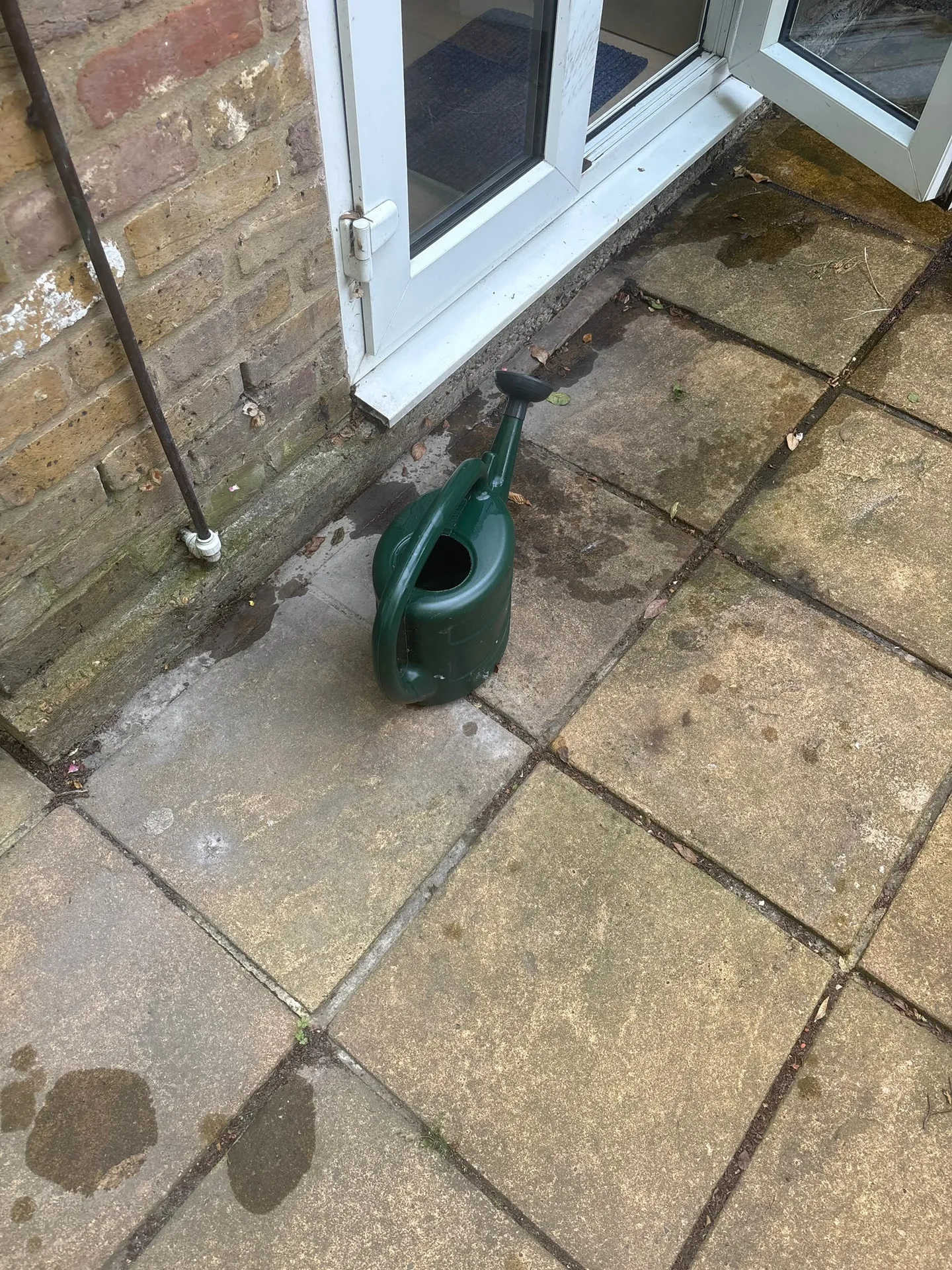
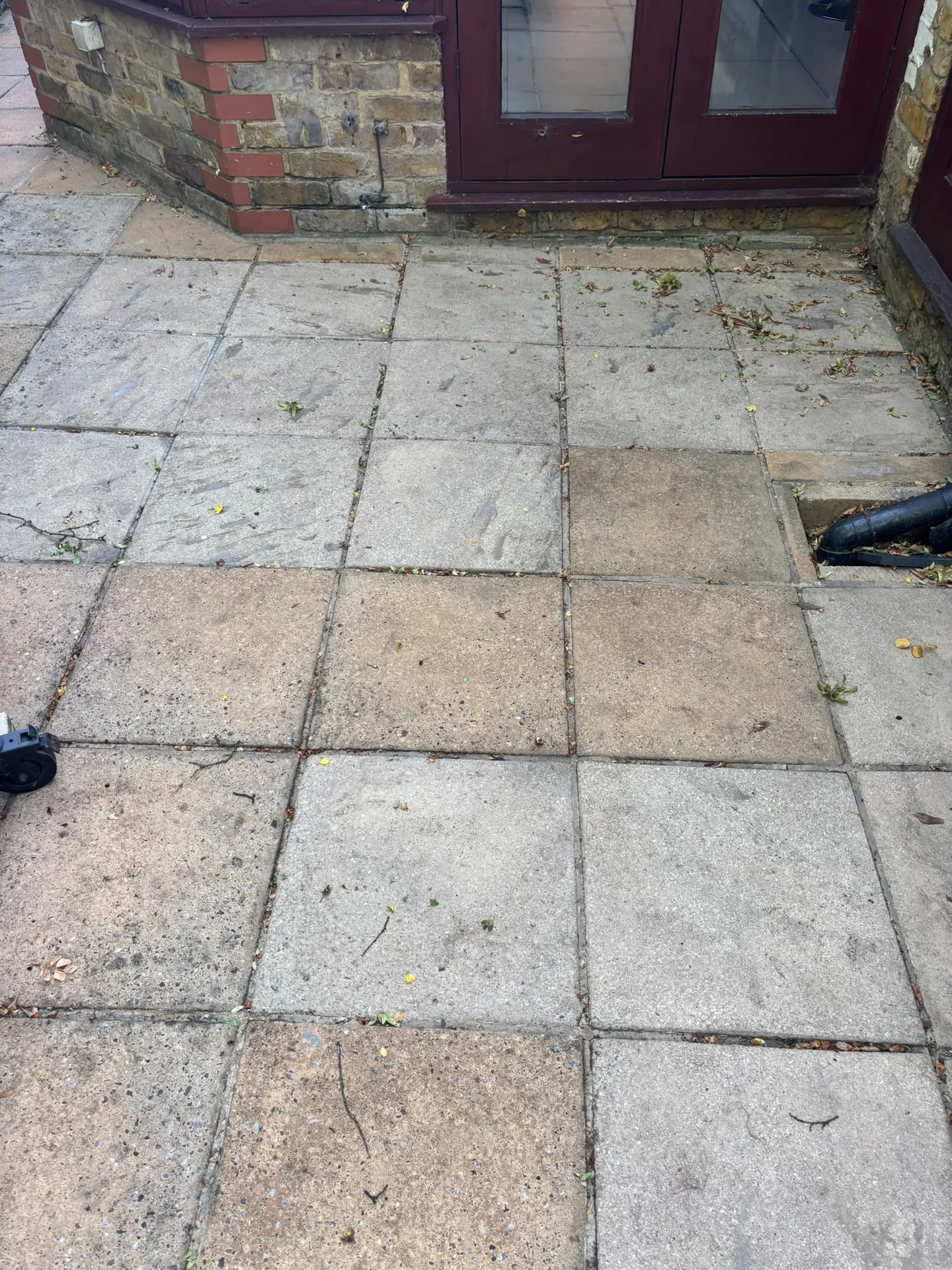
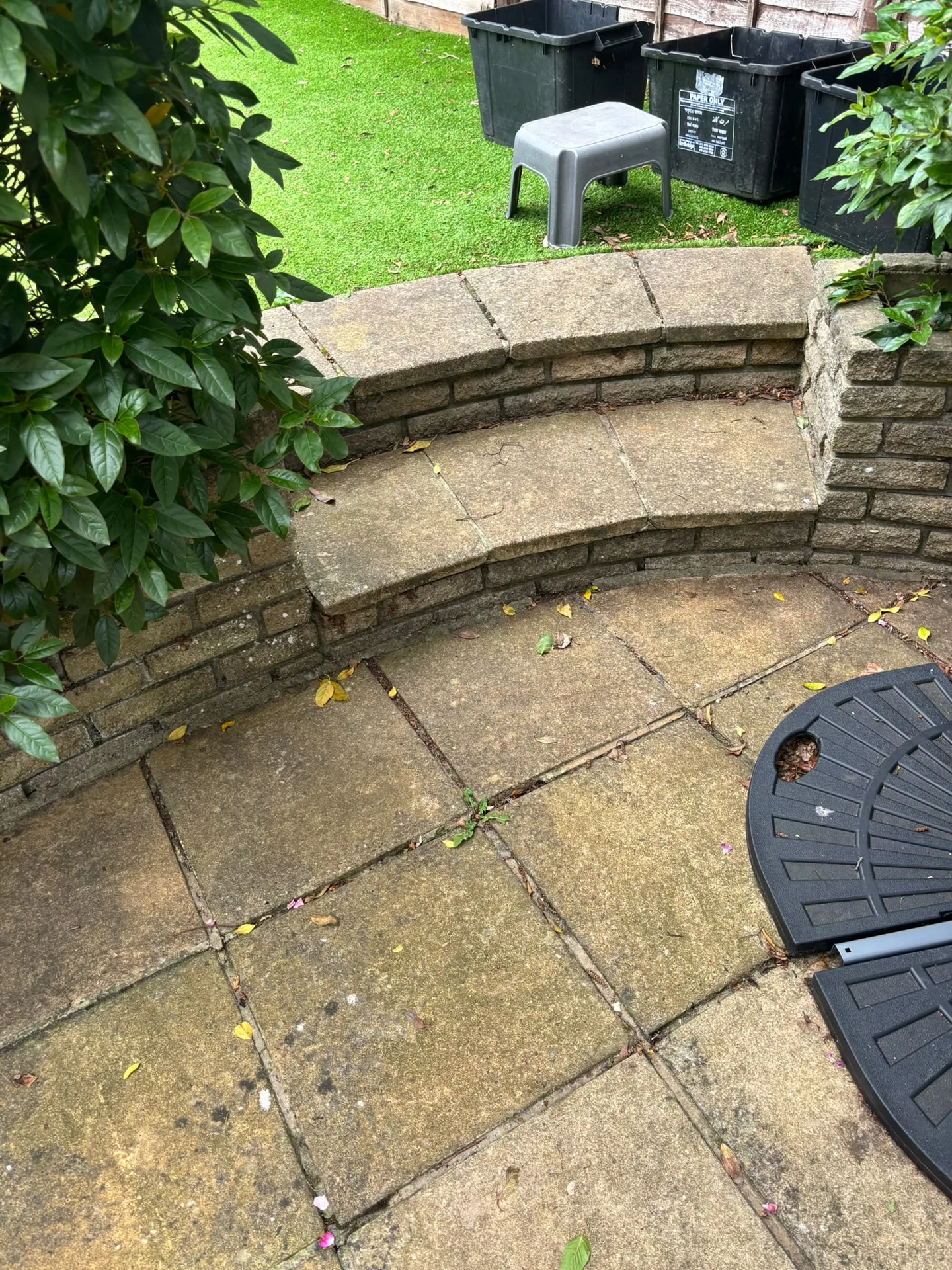
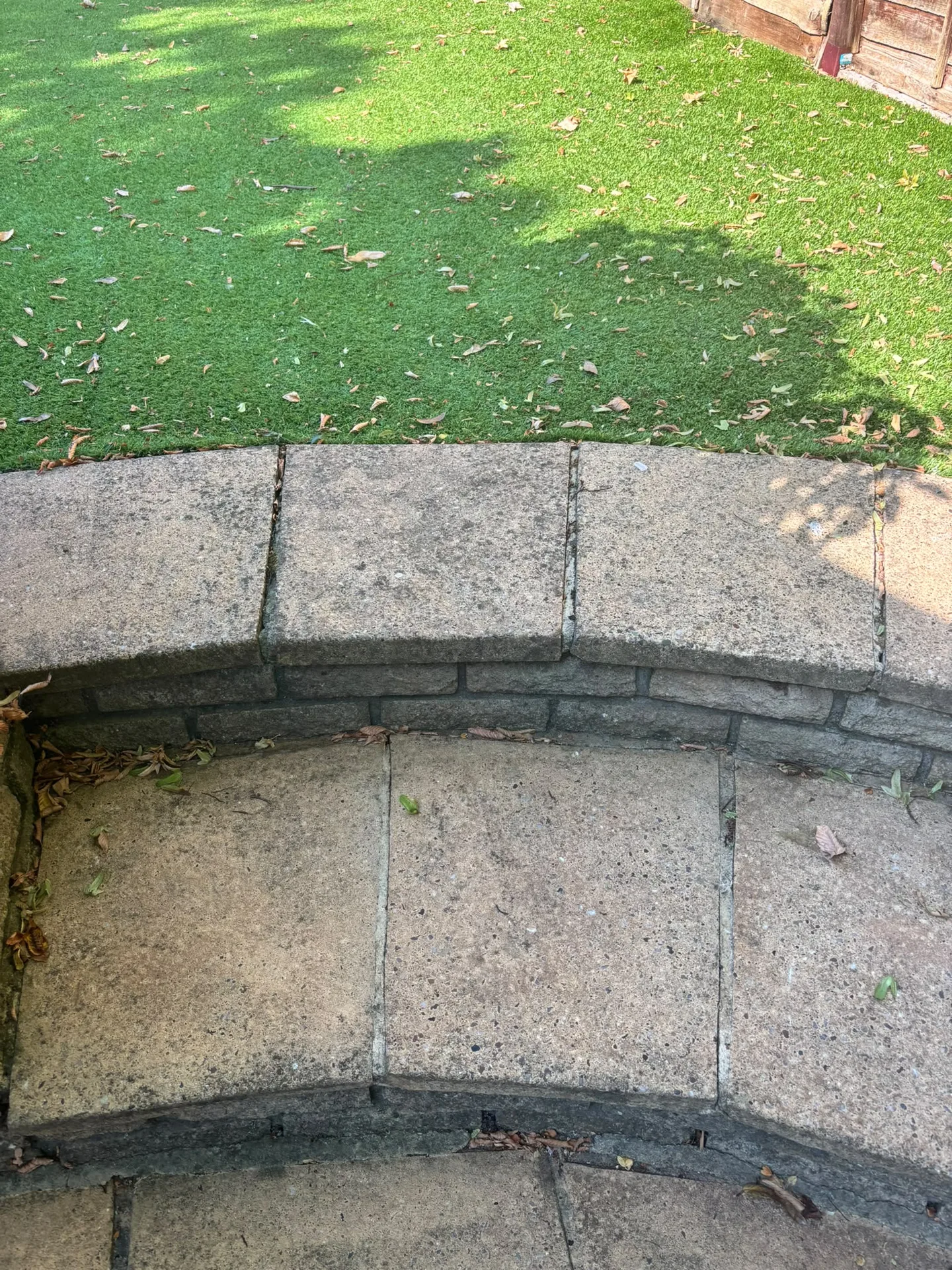
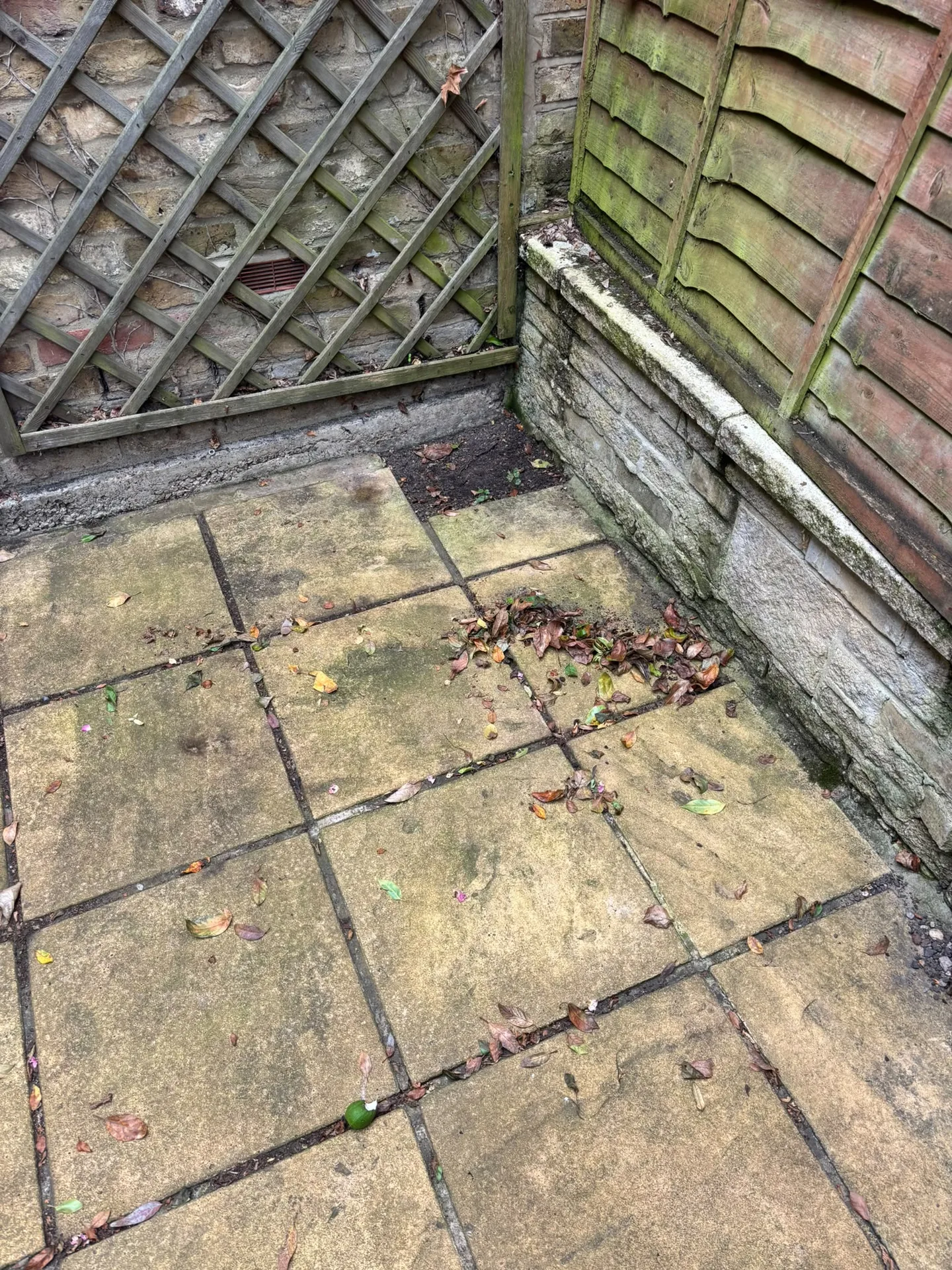
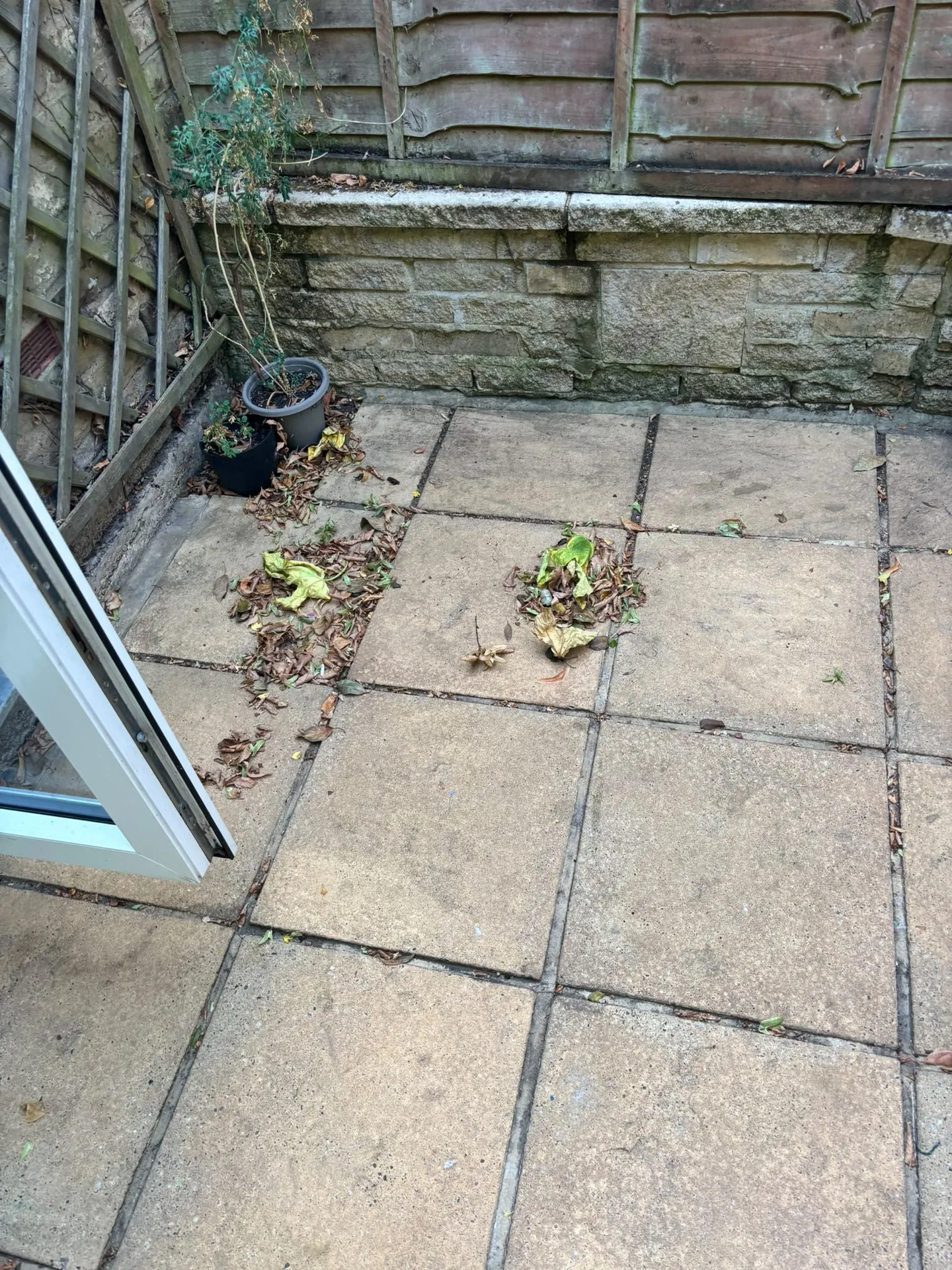
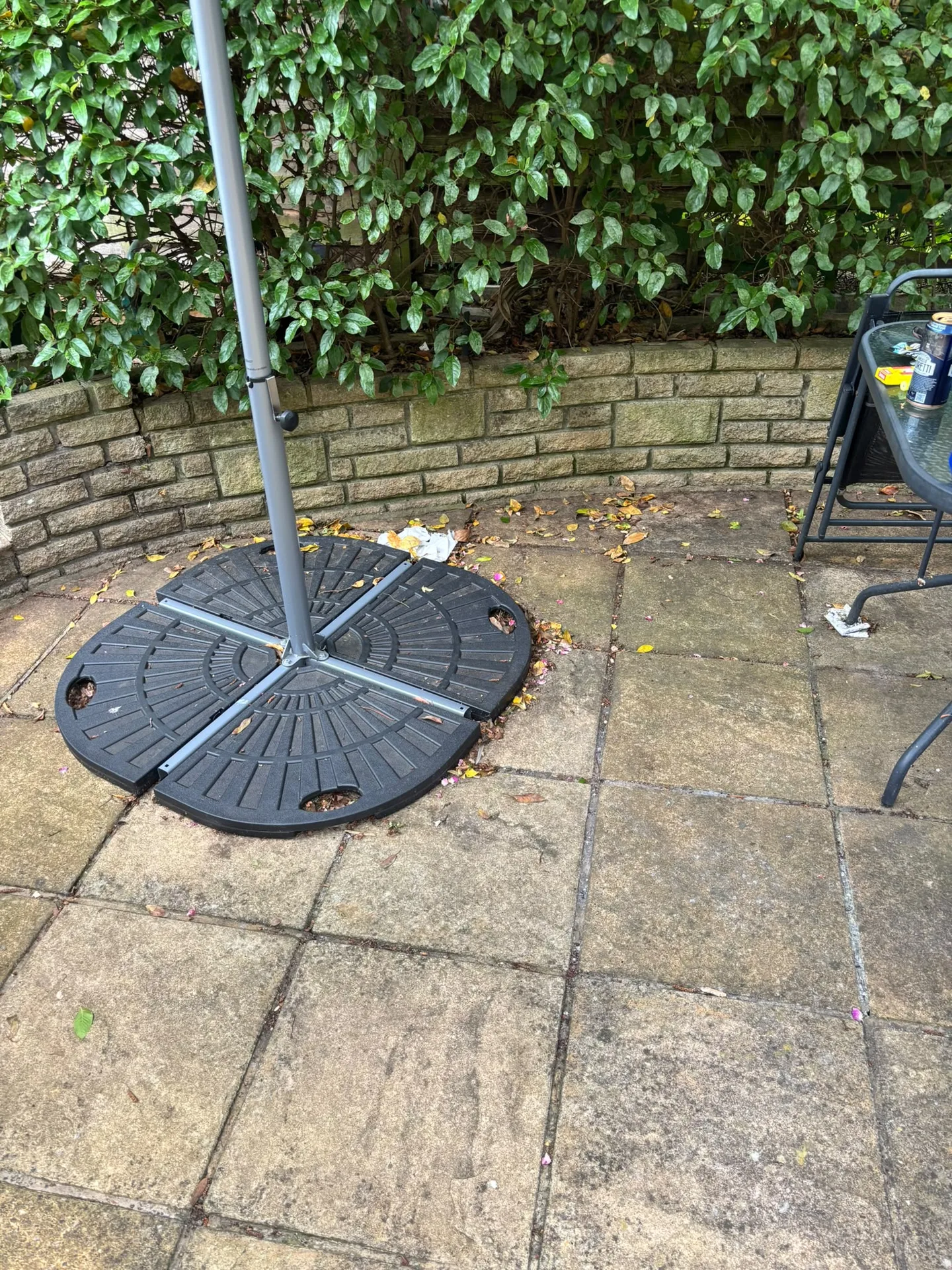
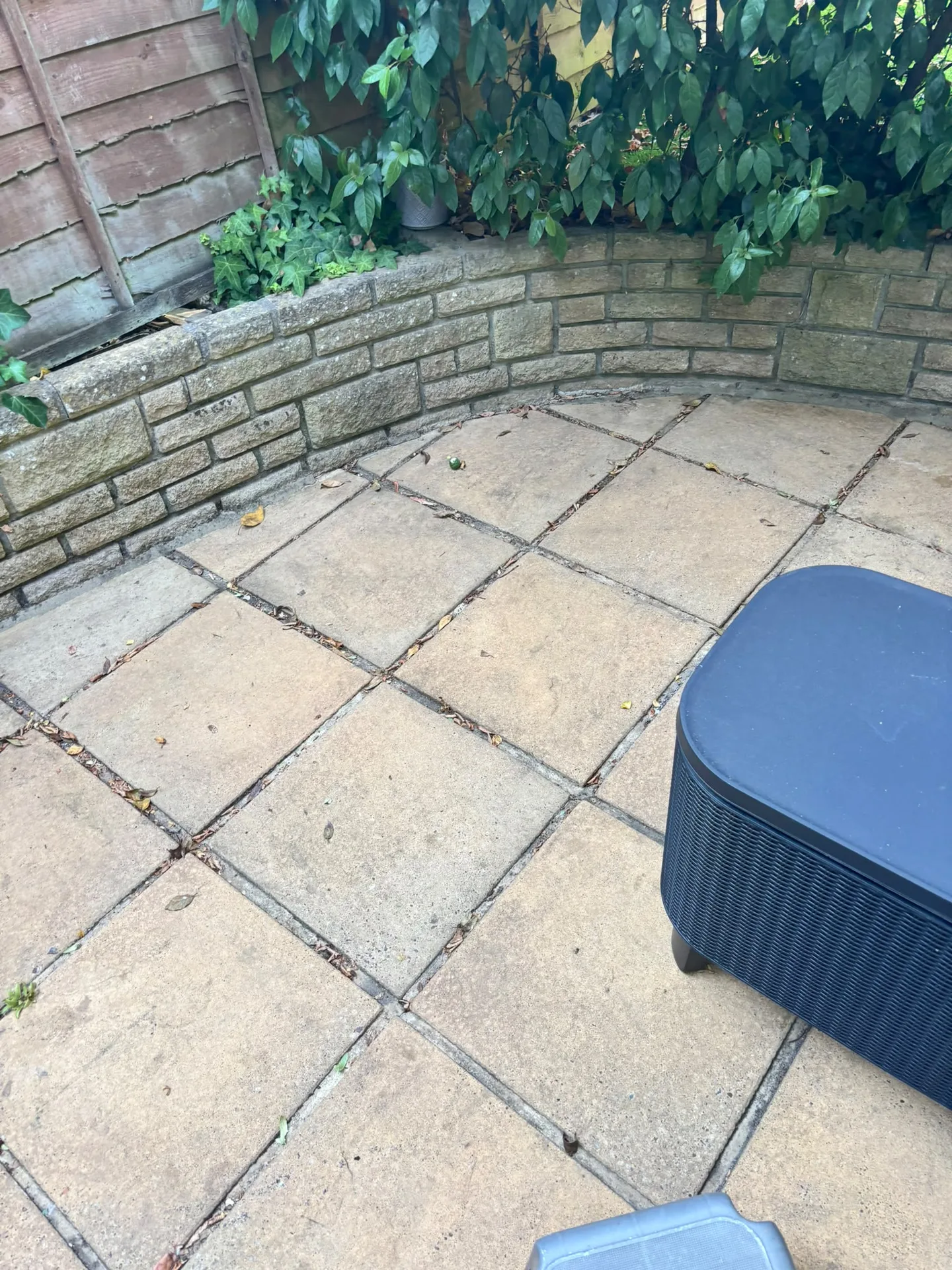
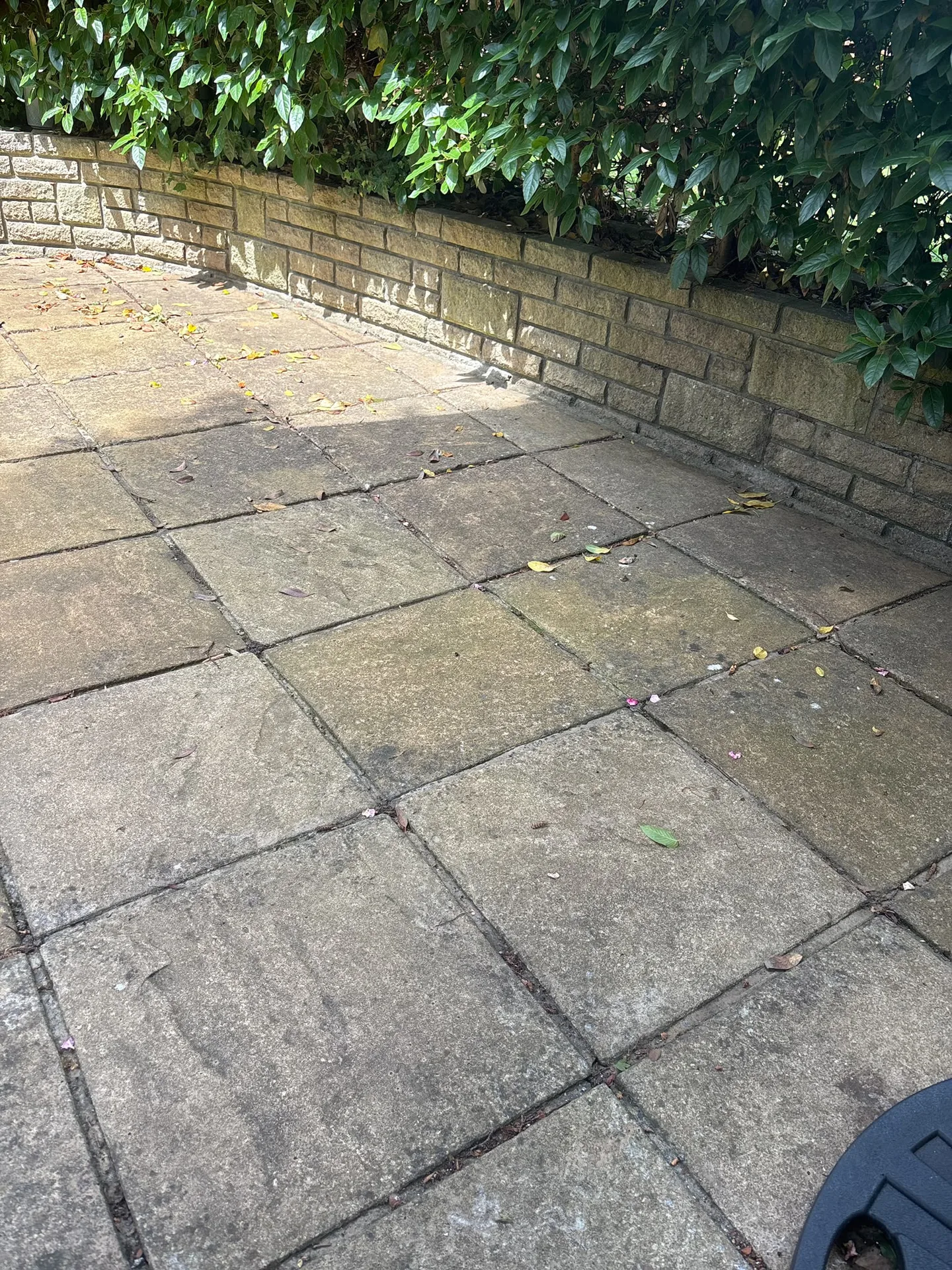
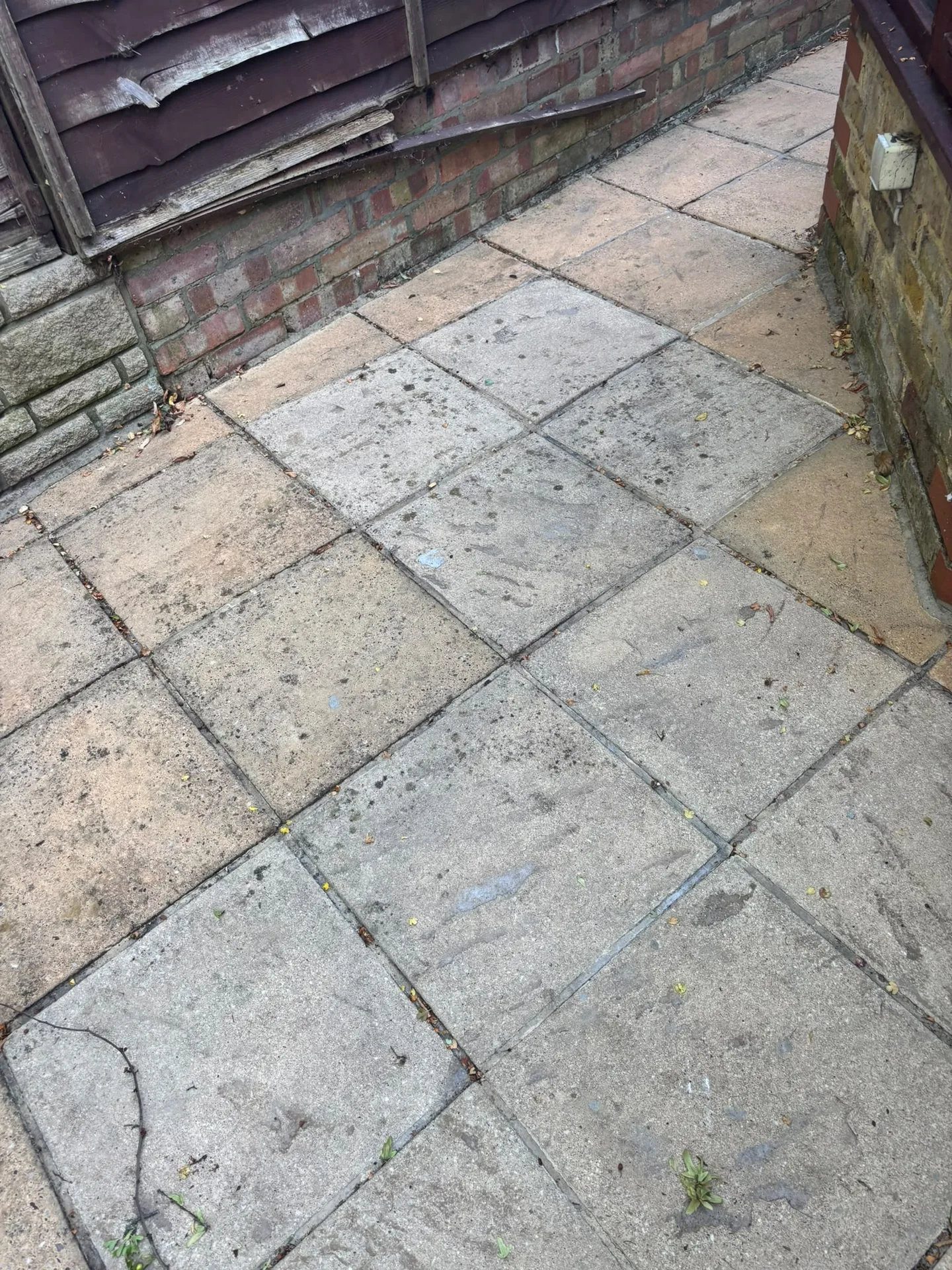
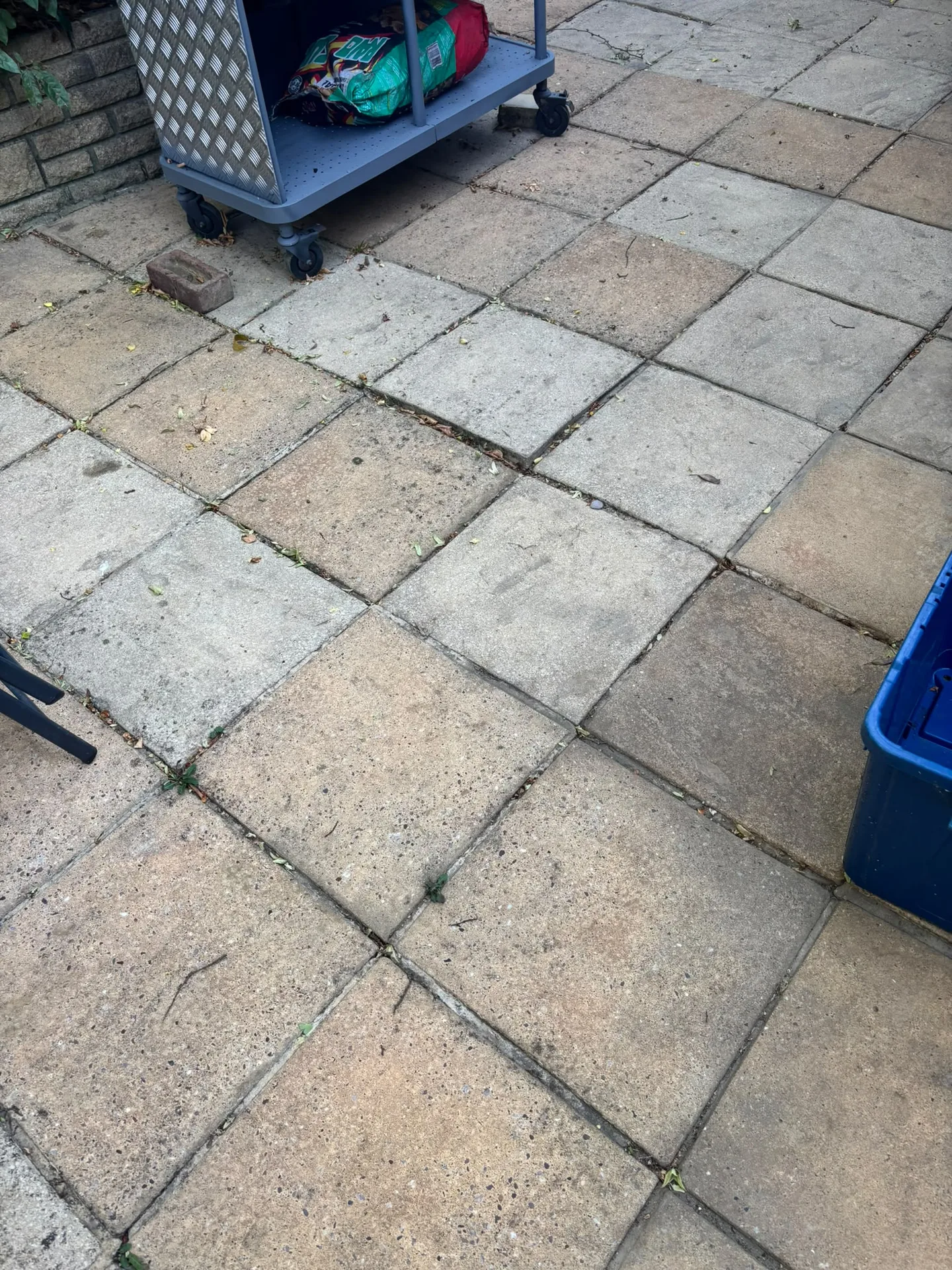
To see the Kärcher K4 in action, look at this recent patio restoration by a client of ours in Woodford, IG8 9JN to whom we recommended the Kärcher K4. The rear garden featured a beautiful natural stone patio, a curved stone seating bench, and a curved pathway. However, due to the heavy London clay soil keeping the garden damp and the shade from adjacent trees, the entire area was heavily stained with thick green algae and dark urban carbon deposits.
Following our recommendations, they used a Kärcher K4 Power Control pressure washer to clean the surfaces safely. By pairing the machine with a professional-grade biocide treatment to break down lichens and utilizing the T5 Surface Cleaner, they brought this weathered stone back to life without damaging a single grout line. Below are the real-world before and after results from this Woodford project:
1. Back Door & French Doors Paving Area
2. Built-In Stone Seating Bench
3. Shaded Trellis Garden Corner
4. Curved Seating Area
5. Side Passage & Curved Pathway
The Final Result: Clean, Restored Patio
When to DIY With a K4 and When to Call The Tree Amigos
For the vast majority of routine garden chores, handling the job yourself with a Kärcher K4 is a sensible, cost-effective option. It is perfect for washing down your composite deck in Bromley, cleaning a sturdy concrete driveway in Croydon, or removing winter slime from a well-installed porcelain patio in Greenwich. If you enjoy spending a weekend afternoon keeping your garden tidy and have a sturdy, modern patio installation, DIY pressure washing is highly rewarding.
However, there are several scenarios where DIY pressure washing carries a high risk of damage, or where a domestic machine simply will not cut it. In these cases, calling in a specialist like The Tree Amigos is the safest and most cost-effective path in the long run:
- Delicate or Aged Natural Stone: Hand-cut Indian sandstone, limestone, and slate are beautiful but relatively soft and porous. If they are already showing signs of weathering, high pressure can cause the surface to flake, scale, or delaminate. We use specialized, professional-grade rotary surface cleaners and low-pressure steam cleaning (DOFF system) to sanitize and clean delicate stone without using destructive force.
- Crumbling or Blown Pointing: If your paving joints are already cracking or washing away, using a DIY pressure washer will completely clear them out, leaving the sub-base exposed. We can carefully remove the remaining degraded grout, professionally clean the stone, and repoint the entire patio using high-performance polymeric jointing compounds that form a flexible, frost-proof, and weed-resistant barrier.
- Severe Black Spot and Lichen Infestations: If your sandstone patio has been neglected for years and is covered in black lichens, a domestic pressure washer will not remove them without etching the stone. We use professional-strength, HSE-approved biocides and cleaning agents that chemically dissolve the lichen down to the root, combined with hot-water washes to return the stone to its original quarry-fresh colour.
- Structural and Drainage Issues: If your patio is holding standing water, shifting underfoot, or sinking in areas, a simple clean will not solve the underlying issue. Patios in South and South-East London frequently suffer from movement due to the heavy clay soils beneath. We specialize in hard landscaping design, meaning we can excavate, install robust engineered drainage systems, lay proper MOT Type 1 sub-bases, and rebuild or replace patios so they remain rock-solid for decades.
Frequently Asked Questions About Patio Cleaning in London
Can I use a pressure washer on porcelain slabs?
Yes, porcelain tiles are extremely dense and durable, making them highly resistant to water pressure. However, you must use a wider fan spray or patio head attachment and keep the pressure at a moderate setting (Medium) to avoid washing out the jointing compound between the slabs.
What pressure setting should I use on decking?
For natural timber decking, use a lower pressure setting (Soft to Medium) and keep the nozzle at least 30cm away from the surface, spraying along the wood grain. For composite decking like Millboard or Trex, a light-to-medium wash with a patio head attachment is ideal to prevent scratching or etching the surface.
Will a Kärcher K4 remove algae and black spots from my patio?
The Kärcher K4 will easily remove surface grime and green algae. However, black spot (a stubborn lichen that feeds on minerals in natural stone) usually requires a specialized stone cleaner or professional biocide treatment alongside pressure washing to be completely eradicated.
Could a pressure washer damage my pointing or grout?
Yes. If you spray a high-pressure jet directly at pointing, grout, or jointing sand, it can easily dislodge or crack it, especially if the pointing is older or cement-based. Always hold the nozzle at an angle (never perpendicular) and keep it moving, or use a dedicated patio cleaning head.
Ready to bring your outdoor space to life?
At The Tree Amigos, we handle all aspects of outdoor work with care and creativity. From premium porcelain patios and composite decking installations to complete garden makeovers and reliable monthly maintenance, we treat every South London garden as if it were our own.
Contact Billy and Vincent today to book a free on-site consultation or request a callback.
Book a Free ConsultationThe Tree Amigos Landscaping & Gardening Ltd are premium, founder-led landscaping specialists serving all 32 London boroughs, with a strong presence across South and South-East London, including Greenwich, Lewisham, Bromley, Croydon, and Wandsworth.
Explore More of Our Expert Guides & Services: