Why Decks Fail (and How to Build One That Lasts)
Written by Billy Maddox & Vincent O'Connell, Founders of The Tree Amigos Landscaping & Gardening Ltd
Published: October 2026
DECKING GUIDES | The Tree Amigos
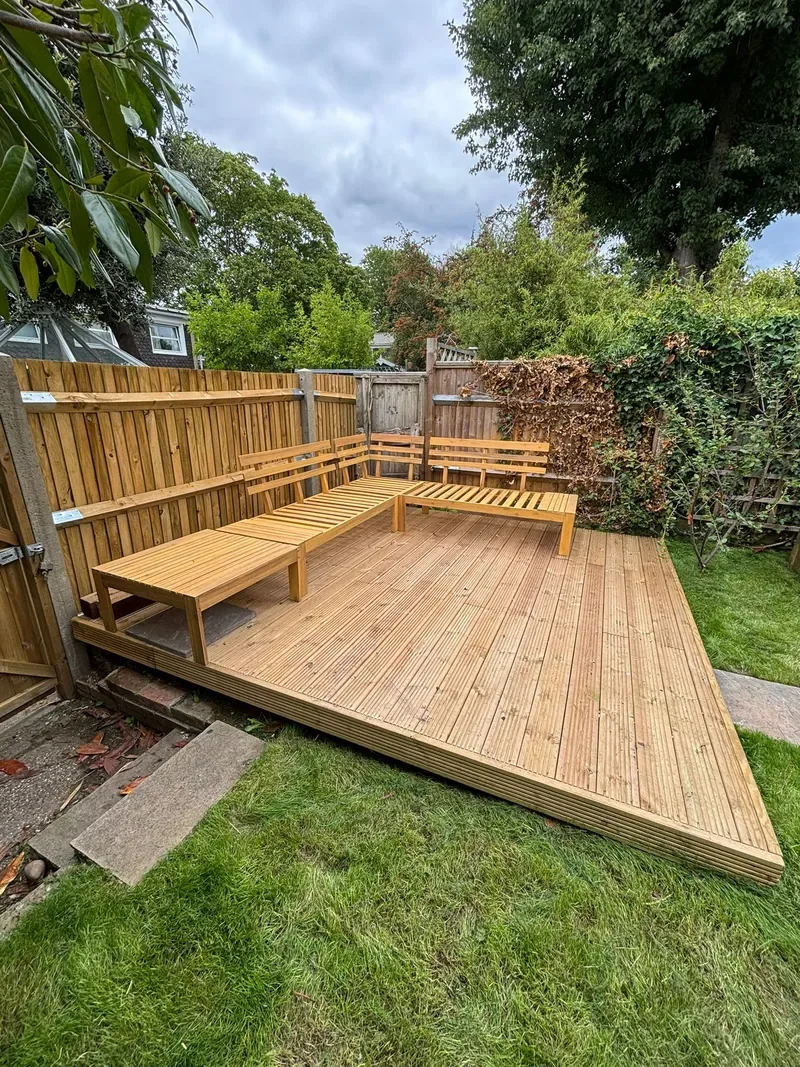
A deck that looks fine on day one can be a problem by year four. Boards warp or fade unevenly, the surface feels loose or bouncy, and when someone looks underneath, the frame is soft. In almost every case the boards were not the main problem. The structure under them was.
Key Takeaways
- Most failed decks fail from underneath: weak frames, wrong timber, no airflow.
- Premium boards on a poor frame will still fail early.
- New boards should only go on a frame that has been checked and is sound.
- Ask any installer what the frame is made of, how far apart the joists are and how the deck is ventilated.
What Installers Are Seeing
In June 2026 the trade magazine Pro Landscaper reported that decks built during the Covid lockdowns are now being replaced after only a few years. Installers quoted in the article, including a London decking firm and a Trex representative, point to the same causes: low-quality products, supply shortages, and inexperienced installers working in a rush.
The specific faults they describe are worth knowing, because you can check for every one of them before you hire anyone.
The Five Most Common Faults
- Timber meant for indoor use. Lower-grade treated timber that is not suitable for outdoor use rots once it is wet. The same goes for fixings that are not made for outdoor conditions.
- An undersized frame. A light frame with joists spaced too far apart lets boards flex, loosen and wear unevenly.
- Boards butted too tightly. Boards expand and contract with temperature and moisture. With no gap, they push against each other and warp.
- Inconsistent or wrong fixings. Fixings that are mixed, missing or poorly set work loose and can end up protruding above the surface.
- No ventilation underneath. A frame that cannot dry out stays damp, and moisture is what rots timber and shortens the life of the whole structure.
Signs Your Deck Is Failing
- Boards that bounce, feel soft or move underfoot.
- Loose boards, or fixings that have worked up above the surface.
- Boards that cup, twist or fade unevenly.
- Timber that is soft, dark or crumbling when you look underneath.
- Standing water, or algae and moss that returns quickly.
Surface problems such as fading or staining are a board issue. Movement and softness are frame problems, and they are the ones to take seriously.
How We Build a Deck to Last
Whatever board goes on top, we build every deck on the same structure:
- A C24 strength-graded timber frame.
- A breathable membrane over prepared ground.
- Joists at 400mm centres, or 300mm for diagonal board layouts.
- Airflow underneath, so the frame can dry.
- Structural pedestals and deeper footings where the ground is soft or wet, which matters on London clay and riverside ground.
- Boards fixed with the gaps the manufacturer specifies.
This is the same on our decking pages for every area we cover, because the frame is what decides how long a deck lasts. Ground conditions change from one London area to the next, so we check the plot at a free survey before deciding on footings.
Can You Just Replace the Boards?
Sometimes, but only if the frame underneath is sound. If the frame is rotten, undersized or has no airflow, new boards will fail the same way as the old ones. We never lay new boards over an old timber frame. If the existing frame is not sound, it is replaced, and the survey is where we check.
Five Questions to Ask Any Decking Installer
- What grade of timber is the frame, and is it suitable for outdoor use?
- How far apart will the joists be?
- How will the deck be ventilated underneath?
- Are the fixings made for outdoor use, and what gap will be left between boards?
- What exactly does the written quote include?
A good installer will answer all five easily. Vague answers are a warning sign.
Frequently Asked Questions
Why do decks rot so quickly?
Usually because of what is under the boards: timber meant for indoor use, a frame that is too light or has joists too far apart, no airflow underneath so moisture cannot escape, or a frame sitting in damp ground.
Can I just replace the boards on my old deck?
Only if the frame underneath is sound. New boards over a rotten or undersized frame will fail again, so the frame should be checked first. We never lay new boards over an old timber frame; if the frame is not sound it is replaced.
How can I tell if my deck frame is failing?
Warning signs include boards that bounce or feel soft underfoot, loose boards, fixings that have worked up above the surface, boards that cup or twist, standing water, and soft or crumbling timber when you look underneath.
What should I ask a decking installer before hiring them?
Ask what grade of timber the frame uses, how far apart the joists are, how the deck is ventilated underneath, whether the fixings are made for outdoor use, and what exactly the written quote includes.
Keep Reading
- Composite vs timber decking
- Do you need planning permission for decking in London?
- Decking maintenance and winter care guide
- Millboard vs Trex
Landscapers in South East London and beyond
We build decks as part of our landscaping work in these areas: Woolwich, Plumstead, Charlton, Blackheath, Eltham, Lee, Thamesmead, Sidcup, Welling, Bexleyheath, Dartford. We also work across London, including Greenwich, Lewisham, Bexley, Southwark, Bromley, Wandsworth, Croydon, Merton.