Do You Need Planning Permission for a Patio? Back and Front Garden Rules (2026)
Written by Billy Maddox & Vincent O'Connell, Founders of The Tree Amigos Landscaping & Gardening Ltd
Published January 2026 · Updated November 2026
PLANNING & RULES | The Tree Amigos
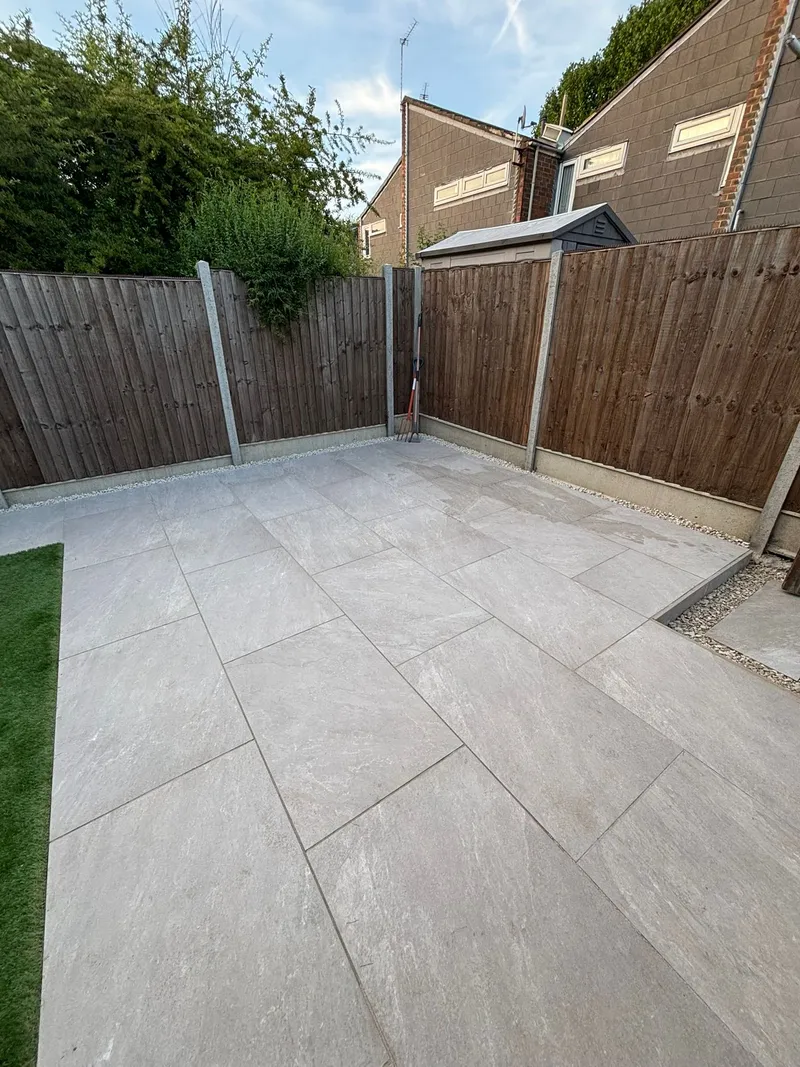
Usually, no. In England, paving a back garden or laying a ground-level patio at a house is normally permitted development, which means you do not need to apply. Four things change that: a surface raised more than 30cm, paving a front garden without proper drainage, living in a flat or maisonette, and being in a listed building or an area where the council has removed permitted development rights. This guide takes each in turn, so you can tell where you stand before you spend anything.
Key Takeaways
- A ground-level patio at the back of a house normally needs no planning permission.
- Anything raised more than 30cm (0.3m) above the ground is outside the permitted limits.
- Paving a front garden with a non-permeable surface over five square metres needs permission unless the water drains to a lawn or border.
- Flats, maisonettes, listed buildings and Article 4 areas are the main exceptions. Your council has the final say.
These are the rules for England, where the permitted development rules for houses are set by the General Permitted Development Order 2015. Scotland, Wales and Northern Ireland have their own rules. This page was checked against the Planning Portal's guidance in October 2026. Rules can change and councils can add their own, so treat it as a guide and confirm with your local planning authority for anything borderline.
The Basic Rule for Back Gardens
Under national permitted development rules, as set out on the Planning Portal, houses in England can make many changes to their gardens without a planning application. A patio laid on the ground in a rear garden falls inside that. In practice, the questions that matter are how high the surface is, what it sits on, and where the water goes.
The 30cm limit for raised areas
The Planning Portal's guidance on outbuildings and platforms gives 0.3 metres (30cm) as the limit for a raised platform. If you are building up a terrace on a sloping garden, or raising a patio to meet a door threshold, measure from the original ground level. If the finished surface will be higher than 30cm, plan for a planning application. If you want a raised deck, our guide to planning permission for decking covers it in more detail, and our guide to raised patio planning permission explains how to measure the 30cm on a sloping garden and what steps, retaining walls and the damp-proof course add.
The 50% rule
The Planning Portal says additions and other buildings must not cover more than half the area of land around the original house. For a patio on its own this is rarely an issue, but a large patio, a shed, an outbuilding and a pergola can add up in a small London garden. Where you are close to the limit, check the figures before you design.
Back Garden or Front Garden: The Rules at a Glance
Where the paving goes changes the answer more than the material does. This table sets the main limits side by side. Each is explained in the sections that follow.
| Question | Back garden | Front garden |
|---|---|---|
| Is planning permission usually needed? | No, for a ground-level patio at a house | Not if the surface is permeable or drains to a lawn or border |
| Size limit on non-permeable paving | No separate limit, but drainage still matters | Over 5 square metres needs permission unless water drains naturally |
| Height limit | 30cm above original ground level | 30cm above original ground level |
| Flats, listed buildings, Article 4 areas | Rules differ. Ask the council | Rules differ. Ask the council |
Paving a Front Garden
This is the rule people get caught by. The Planning Portal says that if you pave a front garden with a traditional, non-permeable surface over more than five square metres, you need planning permission. You do not if the surface is permeable (for example gravel or permeable block paving), or if the rainwater is directed to a lawn or border so it can drain naturally.
The reason is surface water. Paving over front gardens sends rainwater into street drains, which add to flooding in dense areas. If you want porcelain or sandstone at the front, the usual answer is a design where the water falls onto planting or a drained border rather than the pavement. A dropped kerb for parking is a separate application altogether.
What about the back garden?
Back gardens are not covered by the same five-square-metre rule, but drainage still matters. London's clay soils drain slowly, and a large new patio without a plan for the water can leave the garden waterlogged or send water towards the house or a neighbour. Falls away from the property, drains where they are needed, or a soakaway are part of a well-laid patio, whether or not the council asks for them. Our porcelain patio installation work covers the base and drainage as part of the job.
Conservation Areas and Article 4 Directions
A conservation area does not by itself stop you laying a patio at the back. What it does is restrict some other garden structures, and the Planning Portal lists conservation areas among the designated land where, for example, an outbuilding at the side of the house needs permission. Beyond that, many London boroughs have Article 4 directions, which remove specific permitted development rights in a defined area. They are usually street-specific, so the only reliable check is your own council's conservation-area and Article 4 pages.
If your house is listed, the position is stricter. The Planning Portal states that any outbuilding within the curtilage of a listed building needs planning permission, and works that affect the setting of a listed building may need listed building consent. Ask the council before you commission anything.
Flats, Maisonettes and Converted Houses
Permitted development rights apply to houses. Flats, maisonettes and converted houses generally do not have them, so patios, decks and other changes outside a flat can need a full application. There is a second hurdle: if you lease the flat, the freeholder or management company may need to agree to work to shared or demised outdoor space, whatever the council says. Get both answers in writing before ordering materials.
Walls, Fences and Other Garden Structures
A patio often comes with other work. A few limits worth knowing, from the Planning Portal's guidance: a fence, wall or gate generally can be up to 2 metres high in a back garden and 1 metre next to a highway before permission is needed, and an outbuilding or pergola within 2 metres of a boundary is limited to 2.5 metres in height. If a level change needs a retaining wall, check its height and the load behind it, and ask building control if it is more than a low garden wall. See our guides to fencing rules in London and planning permission for a pergola for the detail.
What Happens If You Build Without Permission?
If a patio needed permission and you did not get it, the council can take enforcement action. In England, the time limit for enforcing against building work was extended from four years to ten for work substantially completed on or after 25 April 2024, under the Levelling-up and Regeneration Act 2023. A Lawful Development Certificate is the safe way to get written confirmation that work is lawful. Our guide to planning permission for decking sets out the same time limit.
How to Check Before You Start
- Find your property's planning page on your borough council's website and look for conservation area and Article 4 information for your street.
- Work out the height of the finished surface against the original ground level, and whether any part is over 30cm.
- If the work is at the front, decide how the water will drain before you choose the material.
- If you live in a flat or a listed building, ask the council and, if you lease, your freeholder.
- For a firm answer on a borderline case, apply for a Lawful Development Certificate, which confirms in writing that the work is lawful.
If you would like a second pair of eyes on your garden, we are happy to talk it through at the site visit. We are not the planning authority, so we will always point you to the council for the final answer.
Planning a patio?
Billy and Vincent will look at the garden, talk through the drainage and levels, and give you a written quote with no obligation.
Related reading:
- Porcelain vs sandstone: which is right for your patio?
- Best patio materials for UK weather
- Raised patio planning permission: the 30cm rule
- Planning permission for decking in London
- Planning permission for a pergola
- Planning permission for garden landscaping: the full overview
- Shed base and siting
- Porcelain patio installation in London
- Indian sandstone paving in London
Planning a patio in South West London?
If you are in Merton, Morden, Raynes Park, Wimbledon or Kingston, we can check the planning position for your garden at the free site visit and quote for the build. See our local pages for Merton and Morden, Raynes Park and Wimbledon, or go straight to our free quote form.
Frequently Asked Questions
Do I need planning permission for a patio in London?
Usually not. A patio at ground level in the garden of a house is normally permitted development. You may need permission if the surface is raised more than 30cm, if you are paving a front garden with a non-permeable surface that does not drain to a lawn or border, if the property is a flat or maisonette, if it is listed, or if your council has removed permitted development rights in your area.
How high can a patio or deck be without planning permission?
The Planning Portal gives 0.3 metres (30cm) as the limit for a raised platform. Above that, you should expect to need permission. The height is measured from the ground level before the work starts.
Do I need planning permission to pave my front garden in London?
Not if the surface is permeable, or if it is non-permeable but the rainwater drains to a lawn or border. If you use a non-permeable surface such as standard porcelain or concrete over more than five square metres and the water runs off to the road or a public drain, you need planning permission.
Do I need planning permission for a patio in a conservation area?
Being in a conservation area does not by itself stop you laying a ground-level patio, but conservation areas restrict other garden structures and many have Article 4 directions that remove permitted development rights. Check your council's planning pages for your street before you start.
Do I need planning permission for a patio if I live in a flat?
Flats, maisonettes and converted houses do not have the same permitted development rights as houses, so work outside a flat can need permission, and the freeholder or lease may also restrict it. Check both with the council and your freeholder.
Do I need building regulations approval for a patio?
A normal ground-level patio does not usually need building regulations approval. Raised decks, retaining walls and drainage changes can raise other issues, so ask your council's building control team if you are unsure.
Do I need planning permission to pave my whole back garden?
Usually not. In England, paving a back garden with a hard surface at ground level is normally permitted development for a house. The limits that still apply are the 30cm height limit, the rule that additions and outbuildings must not cover more than half the land around the original house, and the exceptions for flats, listed buildings and Article 4 areas. Drainage still matters, because a large paved area can send water towards the house or a neighbour.
Do the same patio rules apply in Scotland, Wales and Northern Ireland?
No. The rules on this page are for England. Scotland, Wales and Northern Ireland each have their own permitted development rules, so check the planning authority for your area before you start.
What happens if I lay a patio without permission when I needed it?
The council can take enforcement action, which can include being asked to remove or alter the work. In England, the enforcement time limit for building work substantially completed on or after 25 April 2024 is ten years. A Lawful Development Certificate gives written confirmation that work is lawful.
Landscapers in South East London and beyond
Patios and paving are part of our landscaping work in these areas: Woolwich, Plumstead, Charlton, Blackheath, Eltham, Lee, Thamesmead, Sidcup, Welling, Bexleyheath, Dartford. We also work across London, including Greenwich, Lewisham, Bexley, Southwark, Bromley, Wandsworth, Croydon, Merton.